
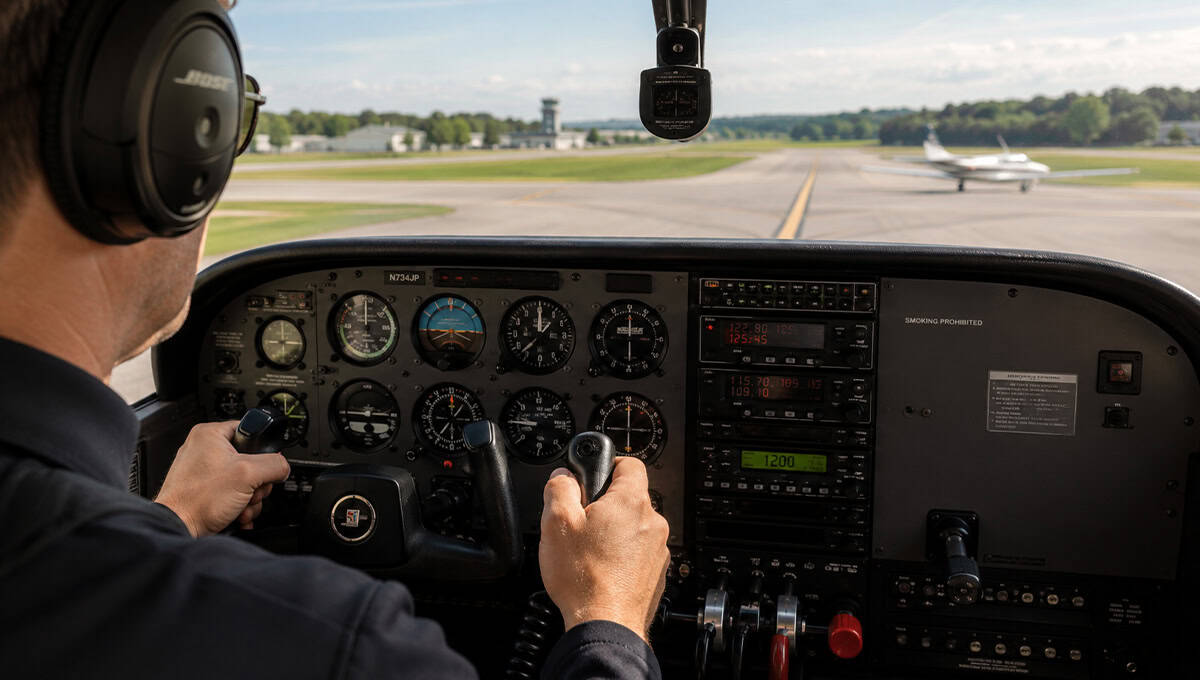
Listen to an air traffic control frequency for the first time and it can sound as though pilots and controllers are speaking a language of their own.
You may hear an aircraft cleared to land on runway “two niner,” a controller tell a pilot to “squawk four six three two,” or a pilot answer with a quick “roger,” “wilco” or “unable.”
Even familiar numbers sound different. Three becomes “tree.” Five becomes “fife.” Nine becomes “niner.”
So, why do pilots say niner instead of nine—and what do all those other aviation radio terms actually mean?
Quick answer: Pilots say “niner” because aviation uses standardized pronunciations designed to make numbers easier to distinguish over noisy, weak or crowded radio frequencies and between speakers with different accents. In standard aviation pronunciation, three becomes “tree,” four becomes “fow-er,” five becomes “fife,” and nine becomes “niner.”
These expressions are not simply pilot slang. Most are part of a carefully developed communication system designed to make important messages short, clear and difficult to misunderstand.
Why Pilots Use Standardized Radio Language
Aviation radio communication has a difficult job.
A transmission may pass through static, engine noise, a weak signal or a crowded frequency. The pilot and controller may have different accents, and only one person can normally transmit on the frequency at a time.
A misunderstood altitude, runway number, heading or call sign can have far more serious consequences than an ordinary conversational mistake.
That is why aviation communication emphasizes three things:
- Accuracy: The message must contain the correct information.
- Brevity: The frequency should not be occupied longer than necessary.
- Clarity: The recipient must understand exactly what was said.
The FAA’s guidance on radio communication describes understanding as the most important part of pilot-controller communication. It also reminds pilots that when standard phraseology is not enough, they should use whatever words are necessary to make the message understood.
In other words, pilots are expected to speak efficiently—but never at the expense of understanding.
Why Do Pilots Say “Niner” Instead of Nine?
“Niner” is the standardized aviation pronunciation of the number nine.
The additional syllable gives the number a more distinctive sound over the radio. A short word such as “nine” can be clipped, distorted or confused when reception is poor. “Niner” is longer and easier to recognize as a complete transmission.
It also works consistently among pilots and controllers from different countries. Aviation is international, so radio language must remain understandable across accents and native languages.
The purpose is not to make pilots sound dramatic. It is to make the number unmistakable.
For example:
- Runway 29 becomes “runway two niner.”
- A heading of 190 degrees becomes “heading one niner zero.”
- Flight level 290 becomes “flight level two niner zero.”
- A tail number ending in 9JP might be spoken as “niner Juliet Papa.”
Why Pilots Say “Tree,” “Fife” and “Fow-er”
Nine is not the only number with a special aviation pronunciation.
The International Civil Aviation Organization pronunciation system gives every digit a clear spoken form. Some sound almost identical to everyday English, while others are deliberately modified.
| Number | Aviation word | Approximate pronunciation |
|---|---|---|
| 0 | Zero | ZEE-RO |
| 1 | One | WUN |
| 2 | Two | TOO |
| 3 | Three | TREE |
| 4 | Four | FOW-ER |
| 5 | Five | FIFE |
| 6 | Six | SIX |
| 7 | Seven | SEV-EN |
| 8 | Eight | AIT |
| 9 | Nine | NIN-ER |
In ordinary domestic radio traffic, some of the differences may sound subtle. You are more likely to notice “tree,” “fife” and “niner” than the prescribed pronunciation of every digit.
However, the principle remains the same: each number should remain recognizable even when the transmission is imperfect.
The Aviation Phonetic Alphabet
Numbers are only half of the system. Pilots also use the ICAO phonetic alphabet to communicate letters.
Instead of saying the individual letters in a tail number such as N734JP, a pilot may identify the aircraft as:
“Cessna Seven Three Four Juliet Papa.”
Using Juliet and Papa is far clearer than trying to distinguish the letters J and P through static.
| A — Alfa | G — Golf | M — Mike | S — Sierra | Y — Yankee |
| B — Bravo | H — Hotel | N — November | T — Tango | Z — Zulu |
| C — Charlie | I — India | O — Oscar | U — Uniform | |
| D — Delta | J — Juliett | P — Papa | V — Victor | |
| E — Echo | K — Kilo | Q — Quebec | W — Whiskey | |
| F — Foxtrot | L — Lima | R — Romeo | X — X-ray |
This is commonly called the NATO phonetic alphabet, although in civil aviation it is more accurately described as the ICAO radiotelephony alphabet.
What Does “Roger” Mean in Aviation?
Roger means that the speaker received the previous transmission.
It does not mean yes, and it does not necessarily promise that the pilot will follow an instruction.
For example, a controller might say:
“Cessna Three Four Juliet Papa, traffic no factor.”
The pilot could answer:
“Roger, Three Four Juliet Papa.”
The pilot is acknowledging receipt of the information.
However, if a controller asks, “Do you have the airport in sight?” the proper answer is not “roger.” That question requires a yes-or-no response.
What Is the Difference Between Roger and Wilco?
Wilco means the message was received, understood and will be followed.
The word is a shortened form of “will comply.”
That makes it stronger than “roger.”
- Roger: I received your transmission.
- Wilco: I received it, understand it and will comply.
Because “wilco” already includes acknowledgment, the expression “roger, wilco” is technically redundant—even though it appears frequently in movies and popular culture.
What Do “Affirmative” and “Negative” Mean?
Affirmative means yes. Negative means no, not correct or permission not granted.
These words are more distinctive over the radio than the very short everyday answers “yes” and “no.”
Example:
Controller: “Cessna Three Four Juliet Papa, do you have the traffic in sight?”
Pilot: “Affirmative, Three Four Juliet Papa.”
If the pilot cannot see the traffic:
“Negative contact, Three Four Juliet Papa.”
Why Do Pilots Say “Say Again”?
Say again means repeat the previous transmission, or a specific part of it.
A pilot should never guess at a clearance that was partially blocked or misunderstood.
Useful examples include:
- “Say again altitude.”
- “Say again runway assignment.”
- “Say again all after direct Madison.”
- “Say again for Cessna Three Four Juliet Papa.”
Standard terminology uses “say again” rather than “repeat.” More importantly, it tells the controller exactly what information the pilot needs to hear again.
There is nothing unprofessional about asking for clarification. Pretending to understand a transmission is far more dangerous.
What Does “Stand By” Mean?
Stand by means wait briefly.
A controller may be coordinating with another facility, issuing a time-sensitive instruction to another aircraft or looking up information.
It is important to understand what “stand by” does not mean.
It is neither an approval nor a denial.
If a pilot requests a runway crossing and the controller responds, “stand by,” the pilot has not received permission to cross. The aircraft must continue waiting until an actual clearance is issued.
What Does “Unable” Mean?
Unable means the pilot cannot comply with a request, instruction or clearance.
It is one of the most important words available to a pilot.
A pilot might be unable to accept an instruction because of weather, aircraft performance, fuel considerations, terrain, traffic or another safety concern.
For example:
Controller: “Cessna Three Four Juliet Papa, maintain 120 knots to the runway.”
Pilot: “Unable 120 knots, Three Four Juliet Papa.”
The pilot should provide helpful information or suggest an alternative when possible, but the first responsibility is to communicate the limitation clearly.
“Unable” is not rude. It is concise safety language.
What Does “Squawk” Mean?
Squawk is an instruction involving the aircraft’s transponder.
A transponder sends identifying and altitude-related information that helps air traffic control track the aircraft.
When a controller says:
“Cessna Three Four Juliet Papa, squawk four six three two,”
the pilot enters 4632 into the transponder.
Some commonly recognized transponder codes include:
| Code | General meaning in the United States |
|---|---|
| 1200 | VFR operations when another code has not been assigned |
| 7500 | Unlawful interference or hijacking |
| 7600 | Radio communication failure |
| 7700 | General emergency |
A pilot receiving services from ATC should normally continue using the assigned code unless instructed otherwise or unless emergency procedures require a change.
What Does “Ident” Mean?
Ident is a request to activate the identification feature on the aircraft’s transponder.
When the pilot presses the IDENT button, the aircraft’s return becomes specially highlighted on the controller’s display for a limited time. This helps the controller match the aircraft on the radio with the correct target.
Pilots should press IDENT when requested, not simply whenever they are trying to get a controller’s attention.
What Does “Read Back” Mean?
Read back means repeat the message or instruction back to the controller.
The purpose is not ceremony. It creates an opportunity for the controller to catch an incorrect altitude, heading, runway or restriction before the pilot acts on it.
Critical items commonly read back include:
- runway assignments,
- hold-short instructions,
- altitudes,
- headings,
- and other important clearance limits.
A proper readback includes the aircraft call sign so the controller knows which aircraft acknowledged the instruction.
For example:
Controller: “Cessna Three Four Juliet Papa, hold short runway two seven.”
Pilot: “Hold short runway two seven, Cessna Three Four Juliet Papa.”
Simply answering “roger” would not confirm that the pilot heard the correct runway.
What Does “Cleared for Takeoff” Mean?
Cleared for takeoff is the authorization to begin the takeoff.
Instructions such as “taxi to the runway,” “hold short,” or “line up and wait” do not authorize the aircraft to take off.
The distinction matters because several aircraft may be moving toward, across or onto the same runway under different instructions.
A pilot should hear and understand the runway assignment and the actual takeoff clearance before beginning the takeoff roll.
What Does “Line Up and Wait” Mean?
Line up and wait means enter the runway, align the aircraft with the runway centerline and wait.
The aircraft is not yet cleared for takeoff.
The controller may be waiting for landing traffic, wake-turbulence spacing, crossing traffic or another operational requirement.
The pilot must remain in position until receiving a takeoff clearance or another instruction.
What Is the Difference Between Mayday and Pan-Pan?
Mayday and Pan-Pan both indicate a serious situation, but they communicate different levels of urgency.
Mayday
Mayday indicates distress and the need for immediate assistance.
The FAA recommends beginning a distress transmission with “Mayday,” preferably repeated three times:
“Mayday, Mayday, Mayday.”
A Mayday call receives absolute priority over other radio communication.
A distress message should communicate as much useful information as circumstances allow, including:
- the station being called,
- aircraft identification and type,
- the nature of the emergency,
- the pilot’s intentions,
- position and altitude,
- and the assistance requested.
However, the pilot’s first job remains flying the aircraft. A perfect radio call is never more important than maintaining control.
Pan-Pan
Pan-Pan indicates an urgent condition that requires timely assistance but is not yet an immediate distress situation.
It is also normally repeated three times:
“Pan-Pan, Pan-Pan, Pan-Pan.”
A Pan-Pan call receives priority over normal transmissions, but a Mayday distress call has higher priority.
The FAA’s distress and urgency procedures provide the official guidance for these calls.
What Does “Zulu” Mean in Aviation?
Zulu refers to Coordinated Universal Time, or UTC.
Aviation frequently crosses time-zone boundaries. Using one worldwide time reference prevents confusion when pilots, controllers, dispatchers and weather services are working in different locations.
The letter Z represents Zulu in the phonetic alphabet, which is why UTC is often called Zulu time.
For example, 1500Z means 1500 UTC—not necessarily 3:00 p.m. at the airport’s local time.
How a Tail Number Becomes an Aircraft’s Radio Identity
For general aviation pilots, radio communication is closely tied to the aircraft’s registration.
On an initial call, a pilot generally identifies the aircraft by its type or manufacturer followed by the registration characters.
An airplane registered as N734JP might be called:
“Cessna Seven Three Four Juliet Papa.”
Once the controller abbreviates the call sign, the pilot may normally use the same shortened version. Until then, the full identification helps prevent confusion with another aircraft.
This is one reason a registration becomes so memorable to a pilot. It is not only printed on the airplane and recorded in the logbooks. It is spoken on nearly every flight.
Our guide to what an aircraft tail number means explains how N-numbers identify U.S. aircraft and why pilots often become personally attached to them.
What a Realistic Radio Exchange Sounds Like
Here is a simplified example of a pilot calling ground control before departure:
Pilot: “Metro Ground, Cessna Seven Three Four Juliet Papa, north ramp, ready to taxi, VFR east with Alpha.”
Ground: “Cessna Seven Three Four Juliet Papa, runway two seven, taxi via Alpha, hold short runway one eight.”
Pilot: “Runway two seven via Alpha, hold short runway one eight, Cessna Seven Three Four Juliet Papa.”
Notice what the pilot does not say.
There is no unnecessary story, greeting or explanation. The pilot identifies the facility, aircraft, location and request. The controller issues the route and restriction. The pilot reads back the runway and hold-short instruction with the aircraft identification.
Short does not mean rushed. Professional radio communication is calm, deliberate and complete.
Do Pilots Always Have to Use Perfect Phraseology?
No pilot speaks perfectly during every transmission.
Student pilots pause. Experienced pilots occasionally miss a call. Controllers may speak quickly during busy periods, and radio reception is not always clean.
Standard phraseology is important because it gives everyone a shared framework. But safety and understanding come first.
A pilot who is confused can say:
- “Say again.”
- “Speak slower.”
- “Confirm altitude.”
- “Unable.”
- “I do not understand the instruction.”
Plain English is better than silence or a confident-sounding misunderstanding.
The famous Fisk Arrival into Oshkosh provides an unusual example of radio efficiency. Controllers identify arriving aircraft visually, and pilots normally acknowledge by rocking their wings instead of filling the frequency with verbal responses.
Pilot Slang Is Not Always Official Phraseology
Movies, online videos and hangar conversations have created a long list of expressions associated with flying.
Some are official aviation terms. Others are military expressions, airline slang, regional habits or jokes pilots share with one another.
That distinction matters.
Good radio technique is not about sounding like a movie pilot. It is about being understood by the controller and every aircraft sharing the frequency.
The FAA’s Pilot/Controller Glossary is the best official reference when there is uncertainty about what a particular ATC term means.
Why Aviation Radio Language Matters
To an outsider, words such as niner, squawk and wilco may sound like traditions from another era.
In reality, they solve a modern and very practical problem.
Aviation radio frequencies are shared. Messages are brief. Conditions are not always ideal. Pilots and controllers need a system that turns complicated instructions into language that can be recognized quickly and repeated accurately.
That is why pilots say “niner.”
It is also why they use Juliet instead of J, say again instead of guessing, and unable when an instruction cannot be accepted safely.
The language may sound unusual at first, but every word has the same goal:
Make the message clear, keep the traffic moving and help everyone get home safely.
The Tail Number Pilots Carry Beyond the Radio
For many pilots, the tail number heard over the radio becomes part of the aircraft’s personality and the pilot’s own aviation story.
It may belong to the airplane used for a first solo flight, the aircraft a family saved years to purchase or the airplane that carried them on an unforgettable cross-country.
That connection is why pilots often choose custom tail number apparel featuring the registration and aircraft silhouette they know so well.
On the radio, it is the aircraft’s call sign. Away from the airport, it becomes a reminder of the airplane and the memories attached to it.
Frequently Asked Questions
Why do pilots say niner instead of nine?
Pilots say “niner” because standardized aviation pronunciation makes the number nine easier to recognize over weak, noisy or crowded radio frequencies and between speakers with different accents.
Why do pilots say tree instead of three?
“Tree” is the standardized aviation pronunciation of three. Removing the “th” sound makes the number easier to pronounce consistently and easier to understand over the radio.
Why do pilots say fife instead of five?
“Fife” is the standardized aviation pronunciation of five. Its sharper consonant sounds help distinguish the number during imperfect radio reception.
What is the difference between Roger and Wilco?
Roger means the previous transmission was received. Wilco means the transmission was received, understood and will be followed.
What does squawk mean in aviation?
Squawk is an instruction involving an aircraft’s transponder. A controller may assign a four-digit code that allows air traffic control systems to identify and track the aircraft.
Why is Mayday said three times?
Repeating Mayday three times clearly identifies the transmission as a distress call and helps prevent the word from being missed or mistaken during poor radio reception.
Can pilots use plain English with air traffic control?
Yes. Pilots should use standard phraseology when possible, but they may use plain English whenever necessary to communicate clearly, explain a problem or clarify an instruction.
Is the aviation phonetic alphabet the same as the NATO alphabet?
Yes. The alphabet commonly called the NATO phonetic alphabet uses the same Alfa-through-Zulu words used in international civil aviation. In aviation publications it is generally called the ICAO phonetic or radiotelephony alphabet.
[…] radio terminology itself is unfamiliar, our guide to why pilots say “niner” and other aviation radio terms explains some of the standardized language heard on aviation […]