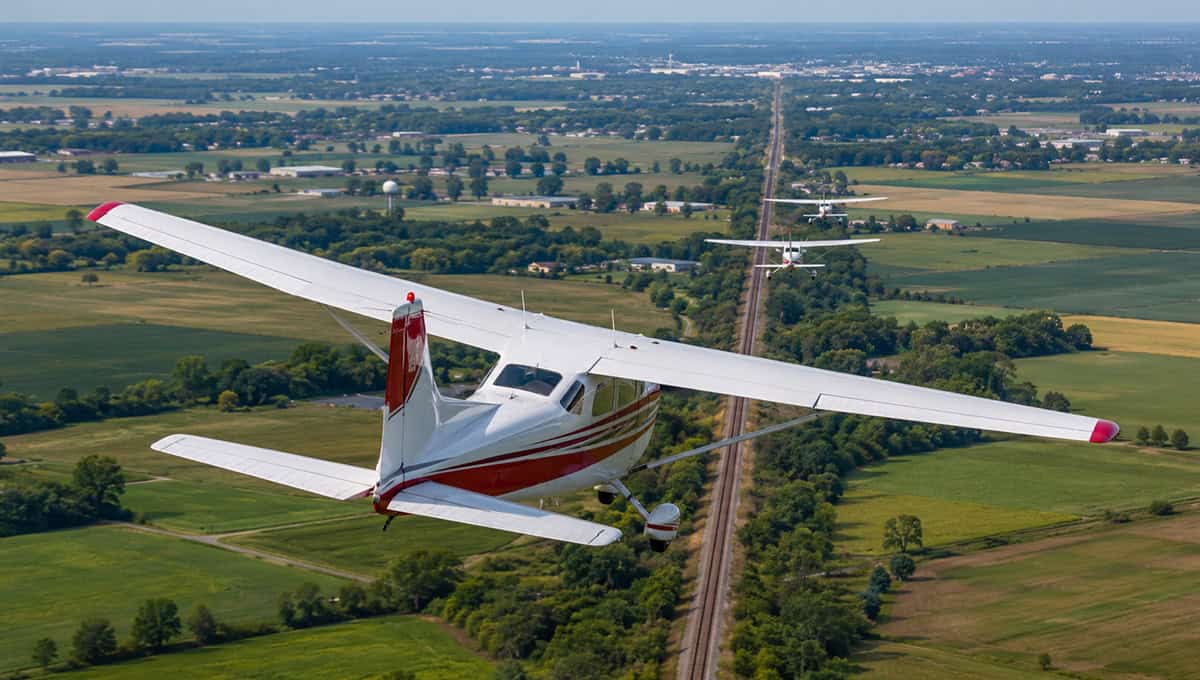
You are flying toward a small Wisconsin town with a line of airplanes stretched out ahead of you.
The radio is busy, but nobody is making the kind of position reports you would expect at a normal airport. Instead, a controller on the ground looks up, identifies your airplane by its color and type, and says something every AirVenture pilot hopes to hear:
“White high-wing over Fisk, rock your wings.”
You gently rock the airplane from side to side.
“Good rock. Continue up the tracks. Welcome to Oshkosh.”
That brief exchange is one of the most recognizable traditions in general aviation—and one of the defining moments of the famous Fisk Arrival into EAA AirVenture Oshkosh.
But why do pilots rock their wings? Why are controllers calling airplanes by color instead of tail number? What are those enormous colored dots painted on the Oshkosh runways?
Here is how the Fisk Arrival works, why it exists and why so many pilots consider completing it an aviation rite of passage.
Important: This article is a general educational overview of the Fisk Arrival and AirVenture culture. It is not a substitute for the current FAA Notice, charts, NOTAMs, weather information, aircraft documentation, flight instruction or a complete pilot briefing. Anyone flying to AirVenture must study and carry the applicable official procedures.
What Is the Fisk Arrival?
The Fisk Arrival is the primary special VFR arrival procedure used by many aircraft flying into Wittman Regional Airport during EAA AirVenture Oshkosh.
During AirVenture week, thousands of aircraft converge on an airport that normally serves a much smaller volume of traffic. Conventional radio calls and standard traffic-pattern procedures would not move that many airplanes efficiently.
The Fisk Arrival creates an organized visual flow of aircraft toward Oshkosh.
Pilots use designated visual transitions toward Ripon, Wisconsin, continue toward Fisk and receive runway and approach instructions from controllers stationed near Fisk. From there, aircraft are routed toward the appropriate Oshkosh runway.
The procedure is carefully described in the official 2026 EAA AirVenture Oshkosh Notice.
For a wider look at the event itself, including visitor planning, aircraft displays and what to expect on the grounds, read our complete EAA AirVenture Oshkosh 2026 guide.
Why Does Oshkosh Need a Special Arrival?
For one week each summer, Wittman Regional Airport becomes one of the busiest aviation environments in the world.
EAA says more than 10,000 airplanes descend on Oshkosh during AirVenture week. That includes high-wing trainers, fast experimental aircraft, vintage airplanes, warbirds, helicopters, ultralights, seaplanes and large turbine aircraft.
They do not all use the same arrival.
Special procedures divide aircraft into appropriate routes and categories. The Fisk Arrival handles much of the VFR general aviation traffic, while separate procedures apply to aircraft such as warbirds, turbines, ultralights and approved mass-arrival groups.
The system works because pilots are expected to arrive prepared, maintain predictable speeds and spacing, listen carefully and follow the published procedure.
It is not an improvised line of airplanes heading toward an air show. It is a highly coordinated operation built around visual navigation, disciplined flying and unusually efficient air traffic control.
Does the Fisk Arrival Always Begin at Ripon?
Pilots commonly describe the procedure as “Ripon to Fisk,” but the complete arrival may begin much farther southwest during periods of heavy traffic.
Under the 2026 procedure, ATC designates the transition starting point being used. Pilots must listen to the Arrival ATIS and Fisk Approach for the currently active transition.
Possible transition points include:
- Endeavor Bridge
- Puckaway Lake
- Green Lake
- Ripon
The longer transitions give controllers more space to organize aircraft before they reach Ripon and the railroad tracks leading toward Fisk.
Once pilots reach the applicable portion of the arrival, they identify an aircraft of similar type and speed to follow. The official procedure requires aircraft to remain in single file, maintain the published spacing and avoid overtaking.
S-turning to create spacing is not part of the procedure. A pilot who cannot maintain suitable spacing is expected to leave the flow and begin again as directed by the Notice and ATC.
This is one reason studying only a video of someone else’s arrival is not enough. The active transition, traffic flow, runway assignment and holding situation can change.
What Happens Between Ripon and Fisk?
The most famous portion of the arrival begins near Ripon.
Aircraft proceed northeast from Ripon toward Fisk while visually following railroad tracks. Pilots remain in trail behind the aircraft ahead while maintaining the appropriate arrival profile for their airplane.
For many aircraft, the published 2026 profile is 90 knots indicated airspeed at 1,800 feet MSL. Aircraft that cannot safely operate at that speed use the alternative provisions described in the official Notice, including the faster profile of 135 knots at 2,300 feet MSL when needed for safety.
These numbers are not casual recommendations. Predictable speed and altitude help keep aircraft separated within an extremely busy visual arrival.
Pilots must continue looking outside, follow the correct aircraft and listen for instructions directed at an airplane matching their type and color.
As the town of Fisk approaches, the workload rises.
The pilot is flying the airplane, watching traffic, maintaining spacing, navigating visually and listening for a controller who may never say the aircraft’s registration number.
Why Do Pilots Rock Their Wings at Fisk?
At Fisk, controllers identify arriving airplanes visually.
A call may sound something like:
“Red and white Cessna over Fisk, rock your wings.”
The pilot rocks the airplane’s wings to confirm that the correct aircraft heard and understood the call.
The wing rock replaces the routine verbal acknowledgement that would normally follow an ATC instruction. Once the controller sees the response, the pilot receives a runway assignment, routing toward Oshkosh and the appropriate tower frequency to monitor.
This keeps the Fisk frequency from becoming overwhelmed with repetitive radio responses.
Imagine hundreds of pilots answering with their full registration numbers, reading back instructions and stepping on one another’s transmissions. The frequency could quickly become unusable.
The wing rock communicates one essential message without adding another voice to the radio:
“That is me, and I heard you.”
EAA describes “rock your wings” as a phrase nearly every pilot recognizes and one that has become synonymous with arriving at AirVenture. For many pilots, it represents the moment when a long cross-country flight finally becomes an arrival at Oshkosh.
Is a Pilot Supposed to Answer Fisk on the Radio?
Normally, no verbal response is required when the controller’s instructions are understood.
The controller calls the aircraft by color and type, requests the wing rock and watches for the visual acknowledgement.
That does not mean pilots are prohibited from speaking when communication is genuinely necessary. The official procedure says a pilot who does not understand an instruction or needs clarification should request instructions on the frequency.
The quiet-frequency concept depends on pilots resisting the urge to make unnecessary calls while still speaking up when safety or understanding requires it.
Good radio discipline at Fisk is not about remaining silent at all costs. It is about avoiding transmissions that the procedure has deliberately replaced with visual communication.
Why Don’t Controllers Use Tail Numbers at Fisk?
At a normal controlled airport, an aircraft’s registration or call sign is central to radio communication.
Fisk is different.
Controllers are looking at a stream of aircraft and making rapid visual identifications. Calling “blue low-wing,” “yellow Cub” or “white Cessna” is often faster than trying to visually read and confirm an N-number from the ground.
The controller’s description also allows pilots in the flow to understand which nearby aircraft is receiving the instruction.
A tail number is still the airplane’s official registration and an important part of its identity. Our guide explaining what an aircraft tail number means covers how N-numbers work and why pilots become so attached to them.
At Fisk, however, aircraft color and configuration temporarily become the most practical call sign.
What Does “Landing on the Dot” Mean at Oshkosh?
After passing Fisk, aircraft are directed toward a runway at Wittman Regional Airport.
Instead of simply being cleared to land somewhere beyond the threshold, a pilot may be instructed to land on—or beyond—a large colored dot painted on the runway.
These dots create clearly recognizable touchdown zones.
By assigning aircraft to different portions of a long runway, controllers can use the available pavement more efficiently. One airplane may be touching down in one section while another aircraft is using a different section under ATC direction.
The dots are large enough to be easily recognized from the air and have become one of the most distinctive features of the Oshkosh arrival.
Depending on the active runway and current instructions, pilots may hear references to colors including:
- White
- Orange
- Green
- Blue
- Pink
- Yellow
- Purple
Runway 36R also uses colored square markings under the current procedure.
Pilots must use only the runway, touchdown point and instructions assigned by ATC. The dots are not targets pilots choose for themselves.
Why Are There Colored Dots on the Oshkosh Runways?
The colored runway markings were developed to help controllers manage increasingly heavy AirVenture traffic.
According to EAA’s history of the Oshkosh runway dots, the first designated touchdown markings appeared on Runway 27 in 1998. The orange and green dots followed in 1999, along with a white dot on Runway 9.
Additional colors were added to other runways as the system developed.
What began as an operational tool has become part of AirVenture culture. Pilots remember which runway they used, which dot they were assigned and what the controller said as they arrived.
“Landing on the dot” is now aviation shorthand for having completed one of general aviation’s most famous arrivals.
Is the Fisk Arrival Difficult?
The individual flying tasks involved in the Fisk Arrival are not necessarily advanced maneuvers.
A qualified pilot should already know how to:
- Maintain an assigned altitude and airspeed
- Follow another aircraft at a safe distance
- Navigate visually
- Listen to ATC while continuing to fly
- Make a stable approach
- Go around when necessary
The challenge is performing those tasks simultaneously in an unfamiliar, high-traffic environment.
A pilot may encounter aircraft traveling at different speeds, changing weather, holding instructions, runway changes, delayed arrivals or another airplane that is not maintaining the expected spacing.
There is also an emotional factor.
After hours of flying toward an event a pilot has dreamed about attending, the temptation to continue can become powerful. That is exactly when fuel status, fatigue, weather and personal limits must remain more important than completing the arrival.
The official Notice repeatedly emphasizes the most important priority: fly the aircraft.
What Makes a Safe Fisk Arrival?
A safer arrival begins well before the airplane reaches Wisconsin.
Pilots should study the complete current Notice, not merely a summary or an arrival video. Maps, frequencies, airport closure periods, holding procedures, runway-specific instructions and ground-operation signs all deserve attention.
Preparation should include:
Practice the Required Aircraft Control
A pilot should be comfortable maintaining the published speed and altitude while looking outside and tracking another aircraft.
That may be worth practicing with a flight instructor before the trip, particularly for a pilot who normally flies faster approaches or has limited experience in dense VFR traffic.
Plan More Fuel Than the Direct Flight Requires
AirVenture traffic can produce delays, holding, go-arounds or diversions.
The official procedure tells pilots to monitor fuel carefully and divert when sufficient reserves for unexpected delays are no longer available.
Arriving with minimal fuel removes options at the exact moment a pilot may need them most.
Know the Alternates Before Reaching the Arrival
Fond du Lac and Appleton are commonly considered by pilots who decide not to continue into Oshkosh, but each airport has its own current procedures and operating considerations during AirVenture.
An alternate should be part of the original plan—not a destination searched for while circling in heavy traffic.
Consider Heat and Aircraft Performance
July heat, aircraft loading and extended ground operations can affect performance.
Pilots should calculate aircraft-specific takeoff, landing and go-around performance rather than relying on how the airplane felt during a cooler flight. Our guide to density altitude and summer aircraft performance explains why familiar airplanes and airports can behave differently in hot conditions.
Be Willing to Leave the Procedure
Breaking off, diverting or trying again later is not failure.
It is aeronautical decision-making.
The most experienced pilot in the arrival is not necessarily the one who presses forward. It may be the pilot who recognizes that the spacing, weather, fuel situation or workload is no longer acceptable.
Can a First-Time AirVenture Pilot Fly the Fisk Arrival?
There is no rule saying the Fisk Arrival is reserved for pilots who have done it before.
Every experienced Oshkosh pilot once made a first arrival.
The real questions are whether the pilot has thoroughly prepared, whether the airplane is suitable, whether the pilot can maintain the required profile and whether the conditions are within that pilot’s abilities and personal limits.
A first-time pilot may benefit from:
- Reviewing the procedure with a CFI
- Practicing the necessary speeds and configurations
- Watching official EAA training material
- Listening to previous Fisk ATC recordings
- Briefing every possible transition and runway
- Arriving with generous fuel reserves
- Choosing a less congested arrival period when practical
- Establishing clear diversion triggers before departure
Pilots who are not comfortable with the operation can land at another airport and continue to Oshkosh by ground transportation.
The value of AirVenture is not determined by which runway you landed on.
Why the Fisk Arrival Means So Much to Pilots
From the ground, a wing rock may look like a small maneuver.
To the pilot, it can represent months or years of anticipation.
It may follow a flight across several states, an early-morning departure, a weather delay or years spent imagining a first trip to AirVenture.
The pilot has studied the Notice, followed the transitions, found the railroad tracks, maintained the flow and finally heard a controller identify the airplane.
Then come the words:
“Rock your wings.”
The response lasts only a few seconds, but it marks the transition from traveling to Oshkosh to arriving at Oshkosh.
After landing, the airplane joins rows of aircraft from across the country. The pilot may camp beneath its wing, walk the flightline and spend the week surrounded by people who understand exactly why that brief wing rock mattered.
That is why the Fisk Arrival is more than an unusual traffic procedure.
It is part of the shared language and culture of general aviation.
More Than an Arrival Procedure
The Fisk Arrival works because pilots and controllers cooperate within a carefully designed system.
Aircraft follow visual transitions. Pilots maintain predictable profiles. Controllers identify airplanes by appearance. A wing rock replaces an unnecessary radio transmission. Colored runway dots divide pavement into usable touchdown zones.
Every part serves an operational purpose.
Together, those parts create one of the most memorable experiences in flying.
For pilots who complete it, the story rarely ends with, “I landed at Wittman Regional Airport.”
They say:
“I flew the Fisk Arrival.”
“I rocked my wings.”
“I landed on the dot.”
And within the aviation community, everyone knows exactly what that means.
Pilots who enjoy wearing the story of their own airplane can also explore custom gear organized by aircraft type, including embroidered hats and polos personalized with an aircraft silhouette and tail number.
Frequently Asked Questions About the Fisk Arrival
What is the Fisk Arrival?
The Fisk Arrival is a special visual arrival procedure used by much of the VFR general aviation traffic flying into Wittman Regional Airport during EAA AirVenture Oshkosh. Aircraft use ATC-designated transitions toward Ripon and Fisk before receiving runway and approach instructions.
Why do pilots rock their wings at Oshkosh?
Pilots rock their wings to visually acknowledge a Fisk controller’s call. The maneuver confirms that the controller has identified the correct aircraft and that the pilot heard the instructions without adding an unnecessary verbal response to the busy frequency.
Do pilots talk to controllers at Fisk?
Pilots generally monitor the Fisk frequency and do not provide routine verbal acknowledgements. Controllers identify aircraft by color and type and look for a wing rock. A pilot who does not understand an instruction or needs clarification should communicate with ATC.
Why does Fisk ATC use aircraft colors instead of tail numbers?
Controllers visually identify aircraft approaching Fisk. Aircraft color and type can be recognized more quickly than a registration number, allowing controllers to manage the flow without asking every pilot to make a conventional initial radio call.
What do the colored dots at Oshkosh mean?
The colored dots identify touchdown zones on the Oshkosh runways. Controllers assign aircraft to particular dots or portions of a runway to use the available runway length efficiently during heavy AirVenture traffic.
What speed is used for the Fisk Arrival?
The official 2026 procedure lists a commonly used profile of 90 knots indicated airspeed at 1,800 feet MSL. Aircraft unable to safely operate at that speed must follow the alternative provisions in the current Notice, including the faster profile where applicable. Pilots must consult the complete current procedure rather than relying on a general summary.
Can any pilot fly the Fisk Arrival?
A properly qualified and prepared pilot operating an appropriate aircraft may use the applicable procedure. However, pilots must honestly evaluate their experience, aircraft capability, weather, traffic, fuel and personal limits. Pilots uncomfortable with the arrival should use a suitable alternate airport.
Is the Fisk Arrival the only way to fly into AirVenture?
No. Separate procedures apply to certain aircraft categories and approved arrival groups. Some pilots also land at nearby airports and travel to Oshkosh by ground transportation. The applicable current FAA Notice determines which procedure should be used.