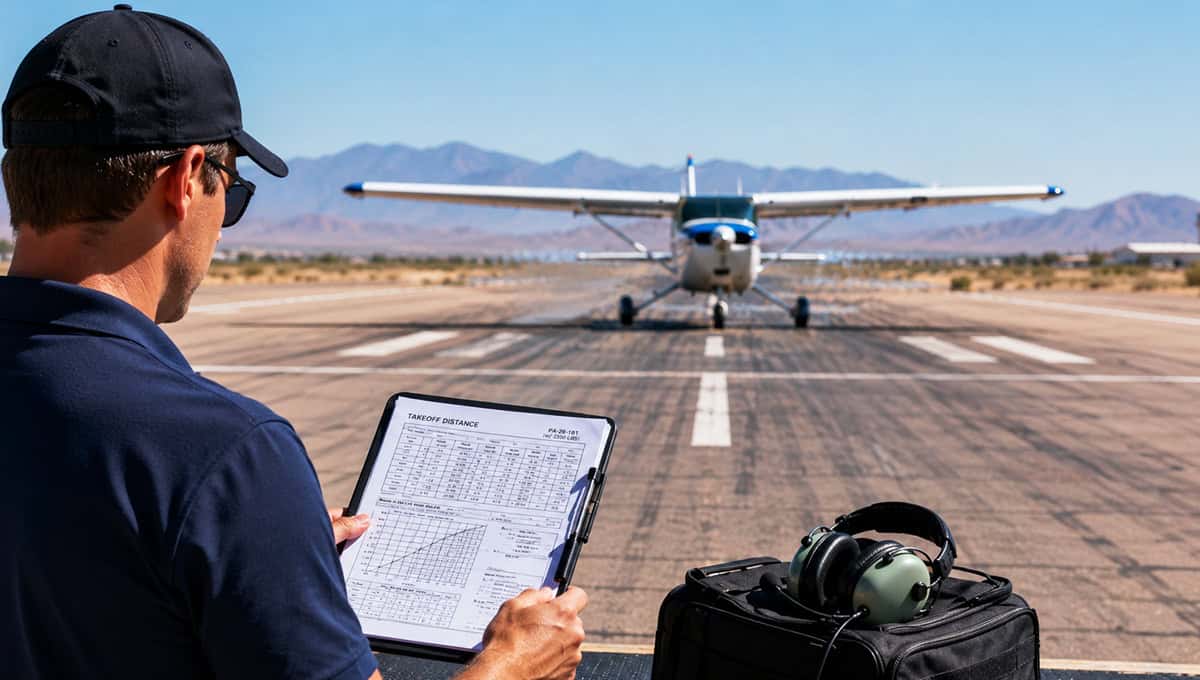
You arrive at the airport on a clear summer afternoon.
The sky is blue, the winds are manageable and the airplane looks exactly as it did during your last flight. The passengers are ready, the baggage is loaded and the runway has not changed.
But the airplane may not perform the same way it did during a cool spring morning.
As the temperature rises, the air becomes less dense. That change can reduce engine power, decrease propeller efficiency, lengthen the takeoff roll and weaken climb performance. The airplane may be sitting at the same airport elevation, but it can perform as though the airport were thousands of feet higher.
That is why understanding density altitude is an important part of summer flight planning.
This guide explains density altitude in practical terms, how it changes aircraft performance and what pilots should consider before departing on a hot summer day.
Important: This article is a general educational overview. It is not a substitute for the approved POH or AFM, aircraft-specific performance calculations, current weather information, weight-and-balance calculations, flight instruction or sound aeronautical decision-making.
What Is Density Altitude?
Density altitude is commonly defined as pressure altitude corrected for nonstandard temperature.
That definition is accurate, but it does not immediately explain why pilots care about it.
In practical terms, density altitude tells you how the airplane is likely to perform in the existing air density. When density altitude is high, the airplane behaves as though it were operating at a higher altitude than the airport elevation might suggest.
For example, an airplane may be parked at a relatively modest airport elevation, but a combination of high temperature and low atmospheric pressure can make the aircraft perform as though it were departing from a much higher field.
Density altitude is therefore not a height to fly or an altitude to display on the altimeter. It is a performance-planning value.
What Causes High Density Altitude?
Several conditions can contribute to higher density altitude:
- High temperature
- High airport elevation
- Lower atmospheric pressure
- High humidity
- A combination of these conditions
The familiar aviation phrase “hot, high and humid” summarizes the environment pilots most often associate with high density altitude.
High-elevation airports deserve particular attention because they already begin with thinner air. However, pilots should not assume density altitude matters only in mountain states. A hot summer afternoon can create a meaningful performance difference at lower-elevation airports as well.
The important question is not simply, “How high is this airport?”
It is, “How will the airplane perform under the conditions that exist right now?”
Why Thin Air Changes Aircraft Performance
An airplane depends on air for several different jobs. The engine needs air to produce power. The propeller needs air to create thrust. The wings need airflow to generate lift.
When the air becomes less dense, all three can be affected.
1. Reduced Engine Power
A normally aspirated piston engine takes in less oxygen when the air is less dense. With less air available for combustion, the engine may not produce the same power it would produce on a cooler day or at a lower density altitude.
Turbocharging can help an engine maintain power through a specified operating range, but it does not make density altitude irrelevant. The wings and propeller are still operating in thinner air, and aircraft limitations and manufacturer procedures still apply.
2. Reduced Propeller Efficiency
A propeller produces thrust by accelerating air. When fewer air molecules are available, the propeller may generate less thrust for a given operating condition.
The result can be slower acceleration and a longer distance before the aircraft reaches liftoff speed.
3. Longer Takeoff Distance
Reduced power and reduced propeller efficiency can combine with higher true airspeed requirements to produce a noticeably longer takeoff roll.
Runway slope, surface condition, wind, aircraft weight and obstacles can further affect the margin available.
A runway that feels comfortably long on a cool morning may provide a much smaller margin during a hot, heavily loaded afternoon departure.
4. Reduced Climb Performance
Getting airborne is only the first part of the departure.
High density altitude can reduce the aircraft’s rate and angle of climb. That matters when the departure path contains trees, terrain, buildings or other obstacles.
A pilot must evaluate more than whether the airplane can leave the runway. The aircraft must also be able to climb safely after liftoff.
5. Higher True Airspeed and Groundspeed
The indicated airspeeds used for takeoff, approach and landing generally remain based on the aircraft’s approved procedures. However, at higher density altitude, the true airspeed associated with a given indicated airspeed is higher.
That can translate into a higher groundspeed during takeoff and landing, especially when wind is light.
The airplane may therefore cover more runway during the same amount of time, contributing to longer takeoff and landing distances.
6. Weaker Go-Around Performance
A go-around requires the aircraft to transition from a landing configuration into a climb while potentially carrying substantial weight and operating close to the ground.
On a high-density-altitude day, the aircraft may accelerate and climb less decisively than the pilot expects.
Go-around performance should be considered during preflight planning, not discovered for the first time after power is applied near the runway.
Why Familiar Airports Can Create False Confidence
Pilots naturally become comfortable at airports they use regularly.
They know where the runway begins, how the airplane usually accelerates and what the normal climb picture looks like over the nose. Familiarity is useful, but it can also create an expectation that every departure will resemble the last one.
Density altitude can quietly change that picture.
The airport, airplane and runway may look familiar while the available performance margin is significantly different. The difference becomes especially important when several unfavorable factors appear together:
- A hot afternoon
- A heavily loaded airplane
- Full fuel
- Little or no headwind
- A soft, wet or grass runway
- An uphill runway
- Obstacles beyond the departure end
No single factor may appear alarming on its own. The combination can be far more consequential.
Morning Departure vs. Afternoon Departure
One of the simplest ways to understand density altitude is to compare two departures from the same airport on the same day.
An early-morning departure may offer cooler temperatures, denser air and better aircraft performance. By mid-afternoon, the airport elevation has not changed, but the higher temperature may increase density altitude and reduce the available performance margin.
This is one reason many pilots prefer earlier departures during hot summer weather.
Flying earlier does not remove the need for calculations or weather evaluation. It may, however, provide more favorable performance conditions while also avoiding some of the heat, turbulence and convective activity that can develop later in the day.
For more ideas connected to early starts and seasonal aviation routines, read Best Summer Flying Traditions Every Pilot Looks Forward To.
How Pilots Can Check Density Altitude
There are several ways to determine density altitude. Pilots may use an electronic flight bag, flight-planning software, an aviation calculator, a manual flight computer or an appropriate performance chart.
The process generally begins with current airport information, including:
- Field elevation
- Altimeter setting
- Outside air temperature
- Current wind
- Runway in use
Pressure altitude is determined first and then corrected for nonstandard temperature to obtain density altitude.
The calculated density altitude should then be used with the performance information provided for the specific aircraft. A density altitude number by itself does not tell a pilot whether a departure is acceptable. It must be connected to takeoff distance, climb performance, aircraft weight, runway conditions and obstacle clearance.
The FAA provides additional density-altitude guidance in its Aeronautical Information Manual.
Use the POH or AFM, Not Memory
Pilots often develop a general sense of how their aircraft performs, but memory should not replace aircraft-specific performance planning.
Review the approved Pilot’s Operating Handbook or Airplane Flight Manual for the conditions of the planned departure. Depending on the aircraft, the relevant information may include:
- Takeoff ground roll
- Distance required to clear an obstacle
- Rate-of-climb performance
- Maximum demonstrated conditions
- Mixture-leaning procedures
- Short-field or soft-field procedures
- Performance-chart assumptions
Pay close attention to the conditions under which published numbers were obtained. Performance charts may assume a paved, level, dry runway, a properly operating aircraft and a specific piloting technique.
Real-world conditions may be less favorable.
Seven Ways to Create a Better Summer Performance Margin
1. Depart During the Cooler Part of the Day
When practical, schedule departures during the morning or another cooler period. Recalculate performance if departure is delayed and temperatures rise.
2. Reduce Aircraft Weight
Aircraft weight has a major effect on takeoff and climb performance. Evaluate whether every passenger, bag and gallon of fuel is necessary for the planned leg while still meeting all legal, operational and reserve requirements.
3. Use the Most Favorable Suitable Runway
Consider runway length, wind, slope, surface and obstacles. The longest runway is not automatically the best runway if other conditions create an unfavorable departure, but additional usable distance can provide valuable margin.
4. Review the Departure Path
Know what lies beyond the runway. Trees, rising terrain and nearby structures can turn marginal climb performance into a serious problem.
Have an appropriate plan for the initial climb and understand where safe maneuvering room exists.
5. Follow Aircraft-Specific Engine Procedures
Use the approved procedures for mixture, power settings and engine operation. Do not apply a technique from another aircraft simply because it worked for someone else.
6. Establish Personal Limits
Legal does not always mean comfortable or wise. Personal minimums can account for experience, runway length, aircraft loading, obstacle environment and forecast temperature.
7. Be Willing to Delay, Unload or Cancel
Sometimes the best performance improvement is a different decision.
Leaving earlier, carrying less weight, making an additional fuel stop or waiting for cooler conditions may turn a marginal departure into a routine one.
A Practical Summer Density Altitude Checklist
Before a hot-weather departure, ask:
- What is the current density altitude?
- What will it likely be at the expected departure time?
- What does the POH or AFM predict for takeoff distance?
- What climb performance can reasonably be expected?
- Does the calculation include current aircraft weight?
- Is the runway paved, dry, level and unobstructed?
- What effect will the wind have?
- Are there trees, terrain or structures beyond the runway?
- What happens if acceleration or climb is weaker than expected?
- Would a cooler departure time provide a better margin?
The goal is not merely to complete a calculation. The goal is to understand what that calculation means for the actual departure.
Density Altitude Matters Beyond Takeoff
Takeoff receives the most attention because the effects are easy to recognize during acceleration and initial climb. However, density altitude can affect the entire flight.
Pilots should also consider:
- Climb performance during the en route portion
- Service ceiling and terrain clearance
- Landing distance at the destination
- Go-around capability
- Performance after a fuel or passenger stop
- Changing temperatures during the day
A destination airport may be hotter or higher than the departure airport. A flight that begins with strong performance may end in much less favorable conditions.
Density altitude should therefore be evaluated for every relevant airport, not only the point of departure.
Summer Flying Rewards Preparation
Summer brings some of the best opportunities in general aviation: breakfast flights, evening patterns, weekend trips, fly-ins and longer cross-countries.
It also brings heat, heavy passenger loads, busy airports and performance conditions that can differ considerably from a cool spring morning.
Understanding density altitude does not make summer flying less enjoyable. It makes the pilot better prepared to enjoy it.
The airplane may look the same. The runway may look the same. But when the air changes, performance changes with it.
Calculate the conditions, review the aircraft data and protect the margin before advancing the throttle.
More Summer Flying From Tail Number Gear
Continue preparing for the season with these Tail Number Gear guides:
- EAA AirVenture Oshkosh 2026: A First-Timer’s Guide
- Best Summer Flying Traditions Every Pilot Looks Forward To
- Flying-Season Essentials Every Pilot Should Have
- Pilot Sunglasses and Hat Essentials
When you are ready to represent the airplane you fly, explore personalized high-wing aircraft gear and low-wing aircraft gear featuring your aircraft silhouette and tail number.
Frequently Asked Questions About Density Altitude
What is density altitude in simple terms?
Density altitude is a way of describing how the airplane will perform in the existing air density. When density altitude is high, the aircraft performs as though it were operating at a higher altitude, which can increase takeoff distance and reduce climb performance.
What weather conditions create high density altitude?
High temperature, high airport elevation, low atmospheric pressure and high humidity can contribute to high density altitude. The combination of hot, high and humid conditions is particularly important.
Does density altitude matter at low-elevation airports?
Yes. High-elevation airports are more susceptible, but very warm temperatures and lower pressure can create elevated density altitude at airports closer to sea level as well.
How does density altitude affect takeoff?
High density altitude can reduce engine power and propeller efficiency, slow acceleration, lengthen the takeoff roll and reduce climb performance after liftoff.
Does high density altitude change indicated takeoff speed?
Pilots should use the speeds and procedures approved for their aircraft. At high density altitude, the true airspeed and groundspeed associated with a given indicated airspeed can be higher, which contributes to longer takeoff and landing distances.
How can pilots reduce density-altitude risk?
Pilots can depart during cooler conditions, reduce aircraft weight, use a suitable runway with adequate margin, evaluate obstacles, review aircraft-specific performance data and delay or cancel when the available margin is inadequate.
Where can a pilot find density altitude?
Density altitude can be calculated with an electronic flight bag, aviation calculator, manual flight computer or performance chart using pressure altitude and outside air temperature. Some airport weather sources and flight-planning services may also display it.