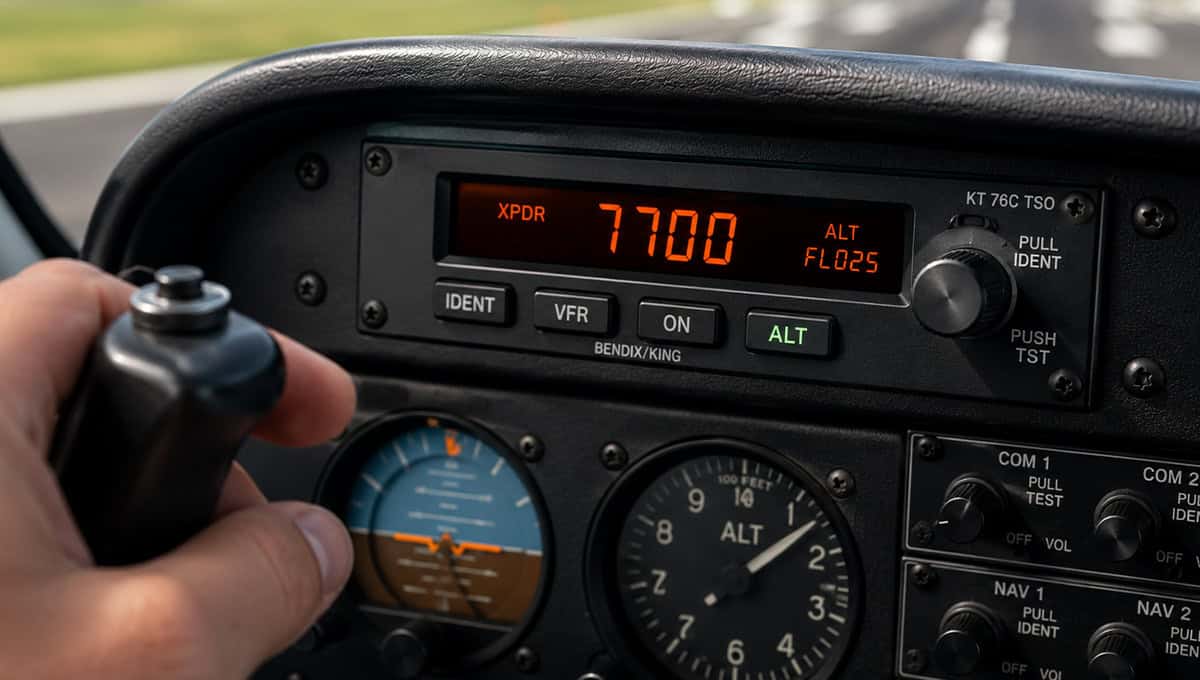
You are watching an aircraft on a flight-tracking app when its status suddenly changes.
Squawk 7700.
Comments begin appearing almost immediately. Is the airplane losing an engine? Is there smoke in the cockpit? Is it diverting? Is it about to make an emergency landing?
The honest answer is that the code alone does not reveal the exact problem.
It does, however, tell air traffic control something important.
Squawk codes 7500, 7600 and 7700 are special aircraft transponder codes used to communicate unlawful interference, radio failure or a general emergency. They allow a pilot to send critical information through the aircraft’s surveillance equipment—even when a complete radio conversation may not be possible.
Quick answer: Squawk 7500 means unlawful interference or hijacking. Squawk 7600 means two-way radio communication failure. Squawk 7700 means a general emergency.
Those definitions sound simple, but each code carries important details that pilots, student pilots and aviation enthusiasts should understand.
Important: This article is a general educational overview. It is not a substitute for current FAA regulations, the Aeronautical Information Manual, aircraft-specific procedures, flight instruction or sound pilot judgment.
What Is a Squawk Code?
A squawk code is a four-digit number entered into an aircraft’s transponder.
The transponder responds to surveillance signals and helps air traffic control identify and track the aircraft. Depending on the equipment installed, it may also transmit pressure altitude, aircraft identification and information used by ADS-B systems.
When a controller tells a pilot:
“Cessna Three Four Juliet Papa, squawk four six three two,”
the pilot enters 4632 into the transponder. That assigned code helps ATC associate the aircraft’s surveillance target with the correct flight.
Transponder codes use only the digits zero through seven. Eight and nine do not appear because the system uses an octal numbering format. With four available positions and eight possible digits in each position, the system provides 4,096 possible codes.
This is one of the many reasons aviation numbers sometimes sound unusual. Our guide to why pilots say “niner” and other aviation radio terms explains how standardized language helps pilots and controllers communicate clearly.
Squawk Codes 7500, 7600 and 7700 at a Glance
| Squawk code | Meaning | What it tells ATC |
|---|---|---|
| 7500 | Unlawful interference or hijacking | The aircraft may be subject to a security threat or unlawful seizure. |
| 7600 | Two-way radio communication failure | The pilot has lost the ability to maintain normal two-way radio communication. |
| 7700 | General emergency | The aircraft is experiencing a distress or urgency condition requiring attention or assistance. |
The codes tell ATC the general category of the problem. They do not automatically explain what caused it, how serious it is or what the pilot intends to do next.
What Does Squawk 7700 Mean?
Squawk 7700 means the aircraft is experiencing a general emergency.
It is the broadest of the three emergency codes. A pilot may use it for many different distress or urgency situations, including:
- engine failure or significant loss of power,
- smoke or fire,
- structural or flight-control problems,
- a serious medical emergency,
- fuel concerns,
- severe weather or icing,
- loss of reliable navigation,
- or another condition that threatens the safety of the flight.
The FAA encourages pilots to request assistance before an uncertain situation develops into a full distress condition. A pilot does not need to wait until the aircraft is falling out of the sky before declaring an emergency.
That is why seeing 7700 does not necessarily mean an aircraft is about to crash. It means the pilot or aircraft system has identified a situation serious enough to alert air traffic control.
Does Every Emergency Require Squawk 7700?
No.
This is one of the most commonly missed details in explanations of emergency squawk codes.
If a pilot is already communicating with an air traffic facility and using an assigned transponder code, FAA guidance generally calls for the pilot to continue using that code unless instructed to change it.
The controller already knows which aircraft is in difficulty, can mark the flight appropriately and can begin coordinating assistance. Changing the code may add little when positive identification and communication already exist.
Squawk 7700 becomes especially useful when the pilot needs to alert a radar facility and cannot immediately establish communication.
In practical terms:
- Already talking to ATC: Declare the emergency and normally retain the assigned code unless ATC instructs otherwise.
- Unable to establish communication without delay: Squawk 7700 and continue attempting to contact an air traffic facility.
The pilot’s first responsibility remains flying the aircraft. Operating the transponder should not take priority over maintaining control, following emergency procedures and reaching a safe landing.
What Does ATC See When an Aircraft Squawks 7700?
FAA radar facilities are designed so that code 7700 normally triggers an alarm or special indicator.
On some en route controller systems, the aircraft’s data block displays EMRG rather than simply showing 7700. Some terminal systems display the shorter label EM.
This immediately draws attention to the aircraft and tells controllers that emergency handling may be required.
Controllers can then work to identify the aircraft, establish communication, understand the pilot’s intentions and coordinate whatever assistance is appropriate. Depending on the situation, that assistance might include:
- priority handling,
- vectors toward a suitable airport,
- weather or airport information,
- traffic separation,
- coordination with other ATC facilities,
- and notification of airport rescue or emergency personnel.
The exact response depends on the aircraft’s location, the nature of the problem and what the pilot needs.
What Does Squawk 7600 Mean?
Squawk 7600 means the aircraft has experienced a loss of two-way radio communication capability.
The problem could involve a radio, headset, microphone, electrical system, frequency selection or another part of the communication chain. The code does not tell ATC exactly which component failed.
It tells the controller something more operationally important:
The pilot cannot maintain normal two-way communication.
When an FAA controller system detects code 7600, some en route displays replace the digits with RDOF, meaning radio failure. Certain terminal systems display RF.
What Should a Pilot Do After Squawking 7600?
The answer depends heavily on whether the flight is operating under visual flight rules or instrument flight rules, the weather, the airspace and the equipment that remains available.
FAA guidance tells pilots to continue trying to reestablish communication. That may include attempting contact:
- on the previously assigned frequency,
- through Flight Service or another appropriate radio facility,
- on the emergency frequency 121.5 MHz,
- or through another aircraft capable of relaying a message.
The fact that the pilot cannot hear ATC does not mean the pilot should stop transmitting. A receiver failure could prevent the pilot from hearing a response while the aircraft’s transmissions remain readable on the ground.
Likewise, a microphone or transmitter failure might prevent the pilot from speaking while still allowing the pilot to hear instructions.
What Happens After a Radio Failure Under VFR?
When a two-way radio failure occurs in visual conditions, the pilot generally continues under VFR and lands as soon as practicable.
“As soon as practicable” does not necessarily mean immediately landing at the nearest piece of pavement. The pilot retains judgment to choose a suitable and safe course of action.
At a tower-controlled airport, controllers may use an aviation light gun to communicate basic instructions through colored light signals if radio communication cannot be restored.
What Happens After a Radio Failure Under IFR?
An IFR communication failure is more involved.
Air traffic control will protect airspace based on the assumption that the pilot is following the route, altitude and clearance-limit procedures contained in 14 CFR § 91.185.
Those procedures depend on the last assigned clearance, expected clearances, the filed route, minimum IFR altitudes and whether VFR conditions can be encountered.
Because lost-communication scenarios can become complex quickly, pilots should review and practice the current procedures with a qualified instructor rather than relying on a short online summary.
What Does Squawk 7500 Mean?
Squawk 7500 means unlawful interference with the aircraft, commonly described as hijacking.
The term “unlawful interference” is broader than the dramatic airline hijacking scenarios usually portrayed in movies. The code identifies a serious security situation in which control or safe operation of the aircraft may be threatened by another person.
When a controller system detects 7500, some en route systems display HIJK, while certain terminal systems display HJ.
Controllers follow special security procedures and avoid unnecessary references to the situation over the radio.
How Does ATC Confirm a 7500 Code?
Because an accidental selection is possible, the controller may ask:
“Verify squawking seven five zero zero.”
If the aircraft is not experiencing unlawful interference, the pilot should clearly state that fact and verify the code selected on the transponder.
If the pilot confirms the code or does not respond, the controller treats the situation as unlawful interference and follows the required procedures.
This allows the pilot to communicate a security emergency even when openly describing the problem over the radio may be unsafe or impossible.
What Is the Difference Between Mayday and Squawk 7700?
Mayday and squawk 7700 can communicate the same general fact—an aircraft is in distress—but they use two different systems.
- Mayday is a spoken radio distress call.
- Squawk 7700 is an electronic transponder alert.
A pilot who can communicate normally may declare:
“Mayday, Mayday, Mayday.”
The pilot can then explain the nature of the emergency, aircraft identification, position, altitude, intentions, fuel remaining and assistance needed as circumstances permit.
If immediate radio contact cannot be established, 7700 can alert surveillance facilities while the pilot continues trying to communicate.
The systems complement each other. One does not make the other unnecessary in every situation.
What Is the Difference Between 7600 and 7700?
Code 7600 communicates a specific problem: loss of two-way radio communication.
Code 7700 communicates a broader emergency but does not identify the cause.
A radio failure may or may not become a general emergency. Losing communication in clear weather near a familiar, quiet airport is different from losing all communication while flying in clouds in congested airspace.
The FAA specifically notes that whether a communications failure constitutes an emergency depends on the circumstances and is ultimately a determination made by the pilot.
What Does Squawk 1200 Mean?
In the United States, 1200 is the standard VFR transponder code when air traffic control has not assigned another code.
A VFR pilot receiving flight following will normally be given a discrete four-digit code. That code allows the controller to identify and track the specific aircraft more easily.
When radar service ends, the controller may tell the pilot to “squawk VFR.” In the United States, that normally means returning the transponder to 1200 with altitude reporting enabled.
Codes used outside the United States can differ, which is why pilots should follow the procedures for the airspace in which they are operating.
Can a Pilot Accidentally Select an Emergency Squawk Code?
Yes, and the FAA specifically warns pilots to avoid passing through 7500, 7600 or 7700 while making routine code changes.
On equipment that changes each digit as it is selected, moving from 2700 directly toward 7200 could momentarily create 7700 and trigger a false emergency alert.
The FAA’s example recommends changing from 2700 to 2200 first and then to 7200.
Modern digital transponders may handle code entry differently, but pilots should understand how the installed equipment works and verify the complete code before activating it.
If an emergency code is selected accidentally, the pilot should communicate with ATC, explain the mistake and set the correct code as instructed.
Does Squawk 7700 Tell the Public What Happened?
No.
Code 7700 tells observers that the aircraft has declared or transmitted a general emergency status. It does not identify the precise reason.
The situation could involve an engine indication, smoke, a passenger medical problem, a pressurization issue, a flight-control concern, fuel, weather or another condition.
That is why speculation based only on a tracking display is often unreliable.
A 7700 aircraft may land normally after receiving priority handling. The problem may be resolved in flight. The pilot may divert as a precaution. In other cases, the emergency may be severe.
The code communicates the need for attention—not the final outcome.
How to Remember 7500, 7600 and 7700
Pilots have created numerous rhymes for remembering emergency squawk codes, but some are overly dramatic and none should replace actual knowledge.
A straightforward method is to memorize the three categories in order:
- 7500: Security — unlawful interference or hijacking.
- 7600: Communication — two-way radio failure.
- 7700: Emergency — general distress or urgency.
The increasing numbers can also be viewed as three separate alerts: security, radio and general emergency.
These are codes a pilot should recognize without having to search for them during a high-workload situation.
Why Emergency Squawk Codes Matter
Aviation depends on multiple layers of communication.
Radio allows a pilot to describe a problem in detail. A transponder allows surveillance systems to identify an aircraft and display its status. ADS-B can connect additional identification and position information to the surveillance picture.
When one communication method is unavailable, another may still help.
That is the real value of squawk codes 7500, 7600 and 7700. Four digits can tell controllers that an aircraft requires unusual handling before the pilot has delivered a complete explanation—or when an explanation cannot be transmitted at all.
The codes do not fly the airplane, diagnose the failure or choose the safest airport. Those decisions remain with the pilot.
But they can bring air traffic control into the problem quickly, clearly and without wasting valuable time.
A Squawk Code Changes, but a Tail Number Stays
A transponder code describes the aircraft’s status during a particular flight. It may change several times between departure and landing.
The aircraft’s registration is different.
A tail number identifies the airplane itself. It appears on the aircraft, in its records and in the call sign spoken over the radio. Our guide explaining what an aircraft tail number means explores how that registration becomes part of an airplane’s identity.
For pilots, that identity often carries memories of first solos, long cross-countries, family trips and years spent flying the same aircraft.
That connection is also why pilots choose custom tail number apparel embroidered with the registration and aircraft silhouette they recognize immediately.
Frequently Asked Questions
What does squawk 7700 mean?
Squawk 7700 means an aircraft is experiencing a general emergency. It can be used for mechanical problems, fire, medical emergencies, fuel concerns, severe weather or another distress or urgency condition. The code does not identify the exact problem.
Does squawk 7700 mean an airplane is going to crash?
No. Code 7700 means an emergency has been declared or transmitted, but many aircraft using the code land safely after receiving priority handling or precautionary assistance.
What does squawk 7600 mean?
Squawk 7600 means the aircraft has lost normal two-way radio communication. The pilot should continue trying to establish contact and follow the applicable VFR or IFR communication-failure procedures.
What does squawk 7500 mean?
Squawk 7500 means unlawful interference or hijacking. Air traffic control will attempt to verify that the code was selected intentionally and will follow special security procedures if it is confirmed or the pilot does not respond.
Should a pilot squawk 7700 after declaring an emergency?
Not automatically. A pilot already communicating with ATC should generally continue using the assigned code unless instructed otherwise. Code 7700 is particularly useful when immediate communication with an air traffic facility cannot be established.
What is the normal VFR squawk code?
In the United States, the standard VFR code is 1200 unless air traffic control assigns another code. Procedures in other countries may differ.
Why do transponder codes not use eight or nine?
Aircraft transponder codes use an octal numbering system. Each of the four positions can contain only the digits zero through seven, producing 4,096 possible combinations.
Can a pilot accidentally squawk 7500 or 7700?
Yes. The FAA warns pilots to avoid passing through emergency codes while changing ordinary transponder assignments. If an emergency code is entered accidentally, the pilot should notify ATC and correct it as instructed.
Do emergency squawk codes work without radio communication?
They can alert a surveillance facility even when normal radio contact is unavailable, provided the aircraft is within appropriate surveillance coverage. Pilots should still continue trying to establish communication because the code alone provides only limited information.
What is the difference between a squawk code and a tail number?
A squawk code is a temporary transponder setting used during a flight. A tail number is the aircraft’s permanent registration and identifying call sign.
Official Aviation References
- FAA Aeronautical Information Manual: Air Traffic Control
- FAA Aeronautical Information Manual: Emergency Services Available to Pilots
- FAA Aeronautical Information Manual: Distress and Urgency Procedures
- FAA Aeronautical Information Manual: Two-Way Radio Communications Failure
- 14 CFR § 91.185: IFR Two-Way Radio Communications Failure