Cold-weather flying can bring smooth air, strong aircraft performance, and some of the best visibility of the year. It can also introduce one of aviation’s most consequential weather hazards: aircraft icing.
For general aviation pilots, understanding aircraft icing is about more than noticing that the temperature is below freezing. Structural ice depends on moisture, temperature, droplet characteristics, the aircraft itself, and the route and altitude being flown. A useful preflight picture therefore comes from combining forecasts, freezing levels, observations, PIREPs, and the limitations of the specific aircraft.
This guide explains the fundamentals for GA pilots, but it is not a substitute for current FAA publications, an aircraft’s approved flight manual or pilot’s operating handbook, qualified flight instruction, or a complete weather briefing for a particular flight.
Quick Answer: What Causes Aircraft Icing?
Structural icing develops when supercooled liquid water contacts an aircraft and freezes. The risk depends on more than outside air temperature alone. Moisture, droplet size, aircraft surface temperature, altitude, and the characteristics of the aircraft all matter.
Ice can disrupt airflow, increase drag, reduce lift, increase stall speed, and affect propellers, windshields, antennas, vents, intakes, instruments, and other aircraft systems.
The practical takeaway: do not treat the freezing level as an icing forecast by itself. Evaluate the complete weather picture, the aircraft’s limitations and icing certification, and a viable way to avoid or exit hazardous conditions.
Why Aircraft Icing Matters
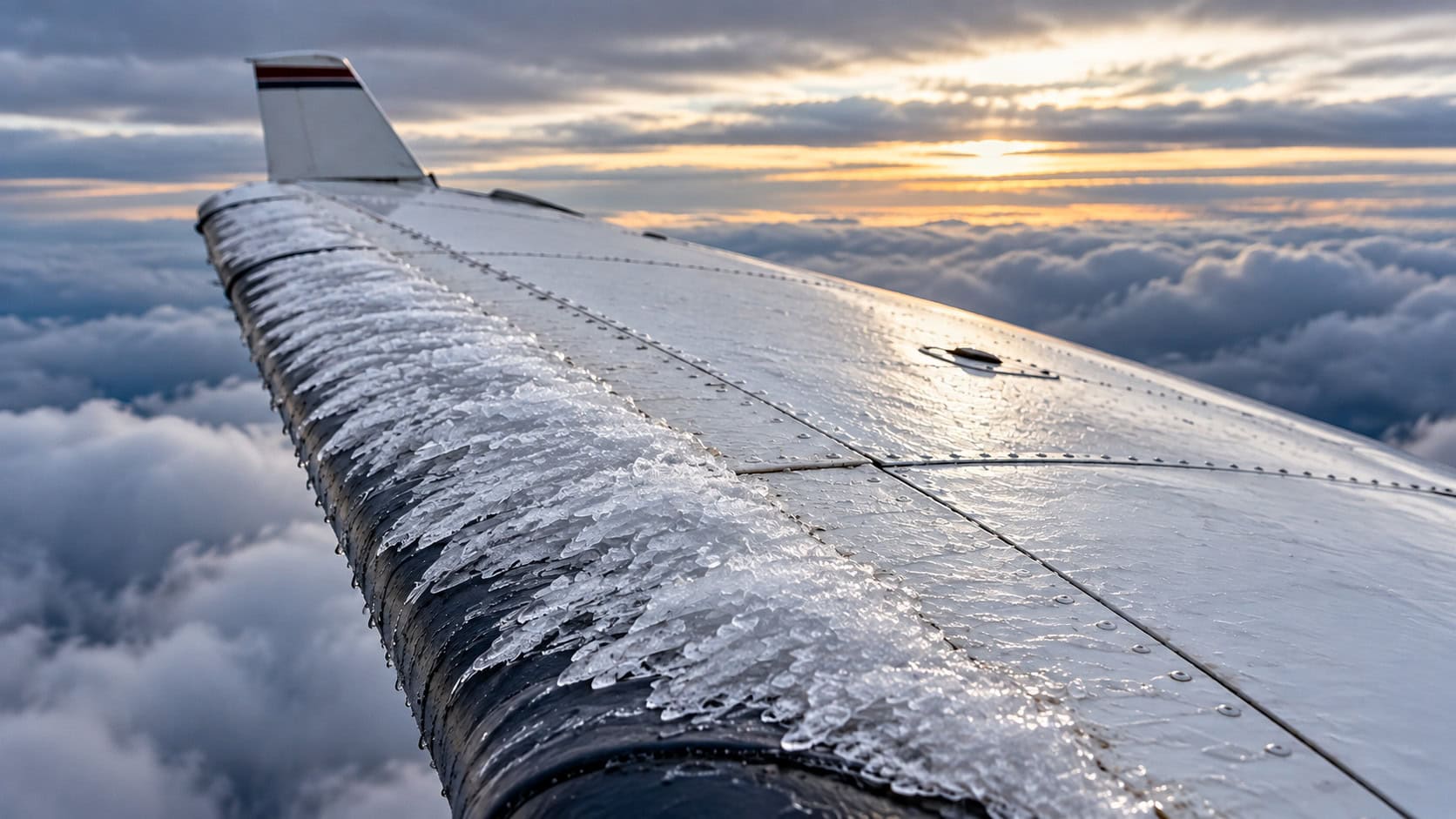
Airframe icing is not simply extra weight attached to an airplane. Its more immediate danger is what ice can do to the shape and airflow of aerodynamic surfaces.
The FAA notes that icing disrupts airflow, increases drag, reduces lift, and can affect propulsion and control systems. Ice can accumulate on wings and tail surfaces as well as propellers, windshields, antennas, vents, intakes, and cowlings.
That means a relatively modest-looking accumulation can matter. The exact effect depends on the aircraft and the shape and location of the ice, which is one reason pilots should resist trying to judge safety simply by estimating how thick the ice looks.
Aircraft icing is not primarily a question of how much ice a pilot is willing to accept. The better question is whether the flight can avoid the conditions that produce it and whether there is a realistic exit if the weather does not behave as expected.
How Structural Icing Forms
One of the central ingredients in structural icing is supercooled liquid water. These are liquid water droplets that remain unfrozen even though their temperature is below 0°C. When those droplets strike an aircraft surface, they can freeze and form ice.
The FAA’s legal interpretation of known icing explains that structural ice formation involves visible moisture and an aircraft surface temperature at or below freezing, while also emphasizing that many variables affect whether ice will actually form and adhere. Droplet size, airfoil shape, aircraft speed, and other factors can change the result.
This is why a simple rule such as “cloud plus below-freezing temperature equals ice” is not precise enough for flight planning. Those ingredients deserve attention, but the actual icing environment is more complicated.
The Freezing Level Is Only Part of the Picture
The freezing level tells a pilot where atmospheric temperature reaches 0°C, but it does not by itself tell you where structural icing will occur.
A pilot evaluating an icing threat also needs to ask whether liquid moisture is present, where cloud layers and precipitation are located, what icing products indicate, what other pilots are actually encountering, and whether the proposed altitude places the aircraft in those conditions.
The Aviation Weather Center’s Graphical Forecasts for Aviation includes icing, icing probability, supercooled-large-droplet information, and freezing-level information. The AWC specifically cautions that its Forecast Icing Product should be used with other available icing information, including G-AIRMETs, SIGMETs, and PIREPs.
Rime, Clear, and Mixed Ice
The FAA uses several terms to describe ice accretion. For GA pilots, three of the most familiar are rime, clear or glaze, and mixed ice.
Rime Ice
Rime ice is rough, milky, and opaque. According to the AIM, it forms when supercooled droplets freeze rapidly after striking the aircraft, trapping air in the ice and giving it a porous appearance.
Clear or Glaze Ice
Glaze ice, commonly associated with the term clear ice, results when supercooled droplets do not freeze immediately on contact. It tends to be denser and harder than rime and can form shapes that extend away from the normal contour of an airfoil.
The AIM makes an important practical point: from the cockpit, the shape of an accumulation may be more meaningful and easier to assess than whether the ice appears perfectly “clear.”
Mixed Ice
Mixed ice combines characteristics of rime and glaze ice. The AIM notes that accurately identifying mixed ice from the cockpit can be difficult.
For pilots, the terminology is useful for understanding and reporting conditions, but identifying the perfect label is less important than recognizing that ice is accumulating and responding according to the aircraft’s approved procedures and the conditions encountered.
Why Freezing Rain and Freezing Drizzle Deserve Special Attention
Freezing rain and freezing drizzle involve supercooled liquid droplets and can create particularly hazardous icing environments.
FAA AC 91-74B explains that the larger droplets associated with freezing precipitation can strike and freeze farther aft on an aircraft than smaller cloud droplets. The AC also cautions that aircraft approval for flight into known icing does not automatically mean approval for freezing drizzle or freezing rain.
That distinction matters. “Approved for known icing” should never be interpreted as permission to fly indefinitely through every form or severity of icing weather. The aircraft’s actual certification, limitations, procedures, and prohibited conditions control.
What Does “Known Icing Conditions” Mean?
This is an area where aviation shorthand can create confusion.
For many GA pilots operating under Part 91, there is not one universal regulation that simply says every flight into “known icing” is prohibited. FAA AC 91-74B notes that the specific icing rule in 14 CFR § 91.527 sits within Subpart F and does not apply to every GA airplane.
Other regulations still matter. Under 14 CFR § 91.9, pilots must comply with the operating limitations specified in the approved aircraft flight manual, markings, and placards. Many aircraft manuals contain limitations concerning flight in known icing conditions. Section 91.103 also requires the pilot in command to become familiar with specified information concerning a flight, including weather reports and forecasts for IFR flights and flights not in the vicinity of an airport.
The FAA Chief Counsel has explained that “known icing conditions” are circumstances in which a reasonable pilot would expect a substantial likelihood of ice formation based on the information available for that particular operation. The FAA emphasizes evaluating the total weather picture rather than treating one broad forecast as an automatic answer.
That analysis can include route, altitude, time, observations, temperatures, forecasts, G-AIRMETs or other advisories, and PIREPs from aircraft actually operating in the area.
Regulatory distinction: aircraft limitations and applicable operating regulations are requirements. FAA advisory material, weather-planning techniques, personal minimums, and conservative avoidance strategies may provide recommendations or risk-management guidance rather than create a new regulation by themselves.
What Does FIKI Mean?
FIKI is common pilot shorthand for an aircraft approved for flight into known icing conditions. The important word is approved.
Having boots, a heated pitot tube, a heated propeller, or another individual anti-ice or deice component does not by itself establish that an airplane is approved for flight into known icing conditions. Pilots need to know the certification basis, limitations, equipment, and procedures for the specific aircraft they are flying.
FAA guidance also makes clear that icing certification has changed over time. Even airplanes approved for icing operations do not have unlimited capability, and some icing environments may fall outside the conditions for which an aircraft was certificated.
The AFM or POH and applicable supplements are therefore the controlling aircraft-specific references, not assumptions based on equipment visible on the airplane.
How Pilots Can Evaluate Icing Before a Flight
FAA guidance encourages pilots to build the icing picture from multiple sources rather than relying on one graphic or one temperature.
1. Start With the Aircraft
Before interpreting the weather, know what the aircraft is approved to do. Review the AFM or POH limitations, applicable supplements, and approved procedures for anti-ice and deice equipment.
An airplane that is not approved for flight in known icing demands a fundamentally different planning approach from an aircraft specifically certificated and equipped for icing operations.
2. Examine Freezing Levels and Temperatures Aloft
Determine where the freezing level lies along the route and how temperatures change vertically. Do not assume that the only useful escape from colder air is downward. Temperature inversions can complicate the vertical temperature profile.
3. Find the Moisture
Compare temperatures with cloud layers, precipitation, frontal structure, and other indications of liquid moisture. Below-freezing air by itself is not structural icing.
4. Check Current and Forecast Icing Products
The Aviation Weather Center’s Graphical Forecasts for Aviation provides icing information at selectable altitudes along with probability, supercooled-large-droplet, and freezing-level information.
G-AIRMETs are also important. The AWC describes G-AIRMET icing as depicting areas of moderate airframe icing, other than convectively induced icing, and includes vertical information relevant to the hazard.
No single graphical product should be treated as a guarantee that icing will or will not be encountered. The AWC specifically describes the Forecast Icing Product as a flight-planning and situational-awareness aid to be considered with the rest of the available weather information.
5. Read the PIREPs
Forecasts tell you what meteorologists and models expect. Pilot weather reports tell you what another aircraft actually encountered.
Icing PIREPs can provide location, altitude, aircraft type, outside air temperature, and the reported type and intensity of icing. Aircraft type matters because icing intensity is aircraft dependent. Conditions reported as manageable by one aircraft should not automatically be assumed to have the same effect on another.
6. Build an Exit Strategy Before Departure
FAA AC 91-74B recommends knowing before flight how icing conditions can be escaped. Depending on the actual weather and terrain, that could involve changing altitude, reversing course, diverting, or landing.
The point is not to memorize one universal escape maneuver. There isn’t one. The useful question during planning is: If this route begins producing ice, where can I go that reliably improves the situation?
That thinking fits naturally with broader fall flying risk management, when changing temperatures, frost, fog, shorter daylight, and faster-moving weather systems may all affect the same trip.
What If You Encounter Ice in Flight?
The correct response depends on the aircraft, the type and severity of the encounter, terrain, weather, available routes, and the procedures in the AFM or POH.
FAA guidance consistently emphasizes avoiding prolonged exposure and having a way out. The FAA Chief Counsel’s known-icing interpretation states that if ice is detected or observed along the route, a pilot should have a viable exit strategy and implement it so the flight can safely continue or terminate at an alternate airport.
For an aircraft not approved or equipped for known icing, the FAA also strongly encourages pilots who encounter icing to make a PIREP and request ATC assistance when appropriate. A timely report can help both the pilot experiencing the problem and other pilots making decisions nearby.
ATC can be an important resource, but ATC assistance does not change the aircraft’s limitations or transfer responsibility for the flight from the pilot in command. Likewise, services such as VFR flight following can add useful ATC support but do not replace weather avoidance or pilot decision-making.
Do Not Forget Ice and Frost on the Ground
Cold-weather icing is not exclusively an in-flight problem.
Frost, ice, and snow on lift-producing surfaces can alter the shape and aerodynamic performance of those surfaces before the airplane ever leaves the runway. FAA cold-weather guidance recommends ensuring that lift-generating surfaces are completely free of contamination before flight and reviewing the aircraft’s cold-weather procedures and limitations.
Do not assume contamination will simply blow off during the takeoff roll. FAA AC 91-74B specifically warns against that assumption.
This is one reason a careful cold-weather preflight deserves extra time. Our Fall Flying Tips for Pilots guide covers frost and several other seasonal considerations that begin showing up well before winter officially arrives.
The Better Cold-Weather Mindset
The goal of learning aircraft icing is not to turn every cold cloud into a source of anxiety. It is to recognize when several pieces of information begin pointing toward the same hazard.
A freezing level is one piece. Clouds and precipitation are another. G-AIRMETs and icing forecasts add context. PIREPs provide real-world observations. The aircraft’s limitations determine what operations are approved. Terrain, alternates, pilot experience, and realistic escape options complete the picture.
When those pieces do not leave enough margin, delaying, diverting, changing the route, changing altitude when appropriate, or staying on the ground are legitimate aviation decisions.
Before cold-weather flights, use current FAA and National Weather Service information, review the limitations and procedures for the aircraft you are actually flying, and obtain the weather information appropriate to the operation. Conditions and forecasts change, and no general article can make a go/no-go decision for a particular flight.
Authoritative Aircraft Icing Resources
For deeper study, pilots can go directly to the FAA’s AC 91-74B, Pilot Guide: Flight In Icing Conditions, the current FAA Aviation Weather Handbook, and the Aviation Weather Center Graphical Forecasts for Aviation.
Frequently Asked Questions About Aircraft Icing
At what temperature can aircraft icing occur?
There is no single cockpit temperature that guarantees structural icing. Supercooled liquid water can exist below 0°C, and actual ice formation depends on moisture, droplet characteristics, aircraft surface temperature, and other factors. Pilots should evaluate the full icing environment rather than use one temperature as a go/no-go rule.
Does flying below the freezing level guarantee there will be no icing?
No. The freezing level is useful planning information, but atmospheric temperature profiles can be complex, including multiple freezing levels and inversions. Pilots should evaluate temperatures, moisture, precipitation, icing products, PIREPs, and the route and altitude together.
What is the difference between rime ice and clear ice?
Rime ice is typically rough, milky, and opaque because small supercooled droplets freeze rapidly and trap air. Clear or glaze ice forms when droplets freeze more slowly and can produce denser, harder accumulations. Mixed ice combines characteristics of both.
Is it illegal for a Part 91 pilot to fly into known icing?
There is not one blanket Part 91 prohibition that applies identically to every GA airplane. Applicable regulations and the aircraft’s operating limitations matter. Under 14 CFR § 91.9, pilots must comply with approved aircraft limitations, which may prohibit flight into known icing conditions. The FAA also considers the pilot’s preflight planning and the total weather information available when evaluating an operation.
Does having deicing boots mean an airplane is approved for known icing?
No. Individual anti-ice or deice equipment does not by itself establish approval for flight into known icing. Pilots should verify the aircraft’s actual certification, required equipment, limitations, and approved procedures in its AFM or POH and applicable supplements.
What weather products are useful when checking for icing?
Useful information can include freezing levels, G-AIRMETs, Graphical Forecasts for Aviation icing displays, icing probability and supercooled-large-droplet information, METARs, TAFs, precipitation and cloud information, and PIREPs. The FAA and Aviation Weather Center emphasize using multiple sources rather than relying on one product alone.
Why are PIREPs especially useful for icing?
PIREPs provide observations of conditions actually encountered by aircraft. An icing PIREP can add information about location, altitude, temperature, aircraft type, and reported icing intensity. Because icing effects are aircraft dependent, the aircraft type and the rest of the weather picture remain important when interpreting a report.