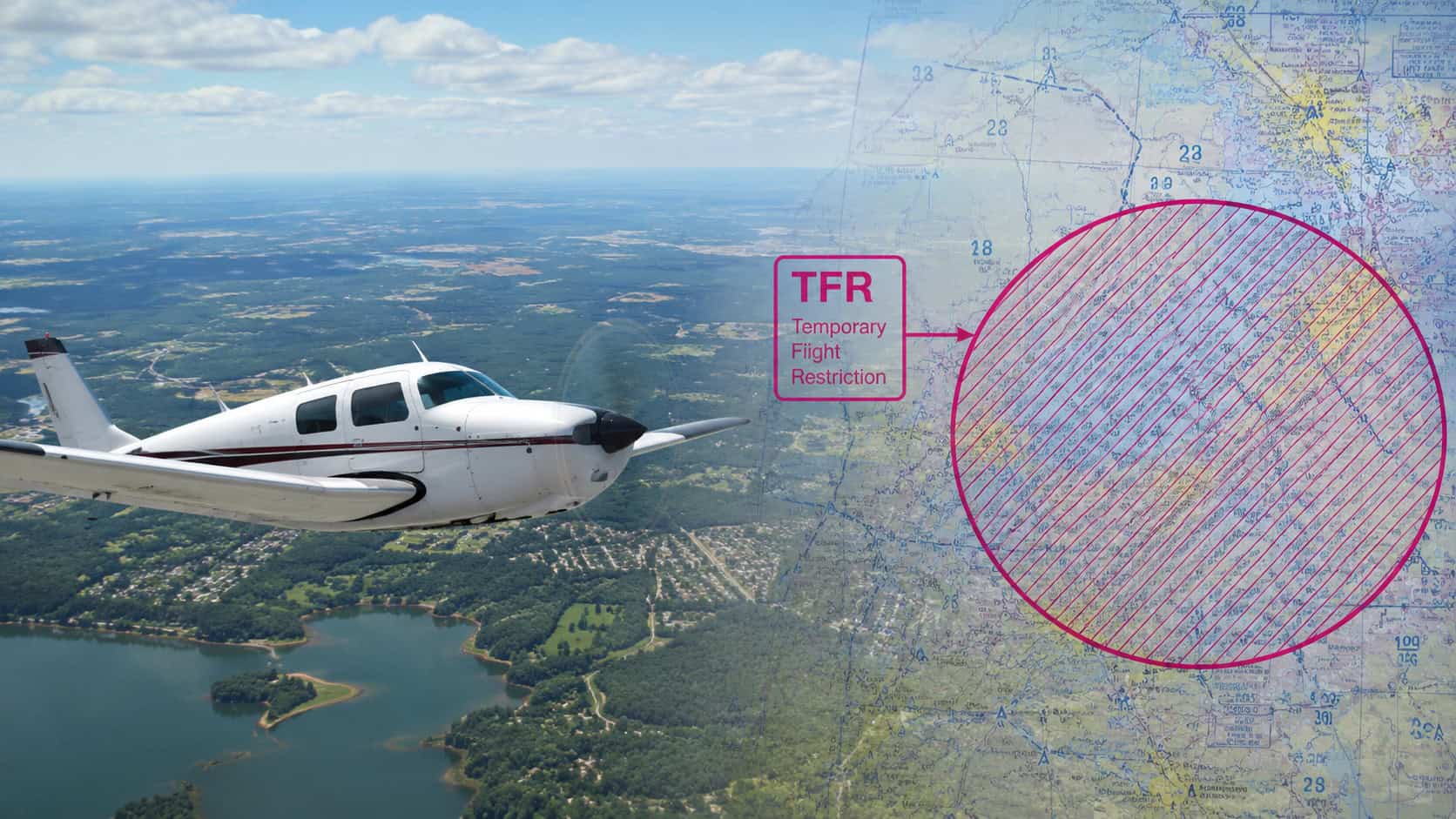
What is a TFR in aviation? The short answer is a Temporary Flight Restriction, a temporary regulatory restriction affecting a defined area of airspace. The practical answer matters more. TFRs can appear for wildfires and disaster response, VIP movement, space operations, aerial demonstrations, major sporting events, and national-security reasons, and the exact rules depend on the restriction actually in effect.
That makes Temporary Flight Restrictions different from the permanent airspace structures pilots learn on sectional charts. A colored boundary on an electronic flight-planning display is useful for awareness, but it does not tell the entire story. Pilots need to understand the current NOTAM, including its effective times, lateral and vertical limits, purpose, and any operations the restriction allows.
Quick Answer: What Is a TFR?
A Temporary Flight Restriction, or TFR, is a regulatory action issued by the FAA through the U.S. NOTAM system that temporarily restricts certain aircraft operations within defined airspace. TFRs may be established for hazards or disaster response, VIP movement, space operations, aviation events, major sporting events, or security purposes.
There is no single universal TFR size, altitude, duration, or set of exceptions. The current NOTAM defines the restriction that applies.
For pilots, the important habit is simple: check current NOTAM information as part of preflight planning and read the actual restriction rather than relying only on a map depiction.
What Is a Temporary Flight Restriction?
The FAA’s current Pilot/Controller Glossary describes a TFR as a regulatory action issued through the U.S. NOTAM system to restrict certain aircraft from operating within a defined area on a temporary basis. The purpose is generally to protect people or property in the air or on the ground, manage an unusual aviation activity, or address a security concern.
The FAA’s Aeronautical Information Manual also makes an important point: the applicable regulations determine what operations are prohibited, restricted, or permitted inside a particular TFR.
Authoritative reference: FAA AIM: Temporary Flight Restrictions
A TFR is therefore not simply a warning area that pilots are encouraged to notice. When a restriction applies to your operation, compliance is regulatory.
Why Does the FAA Issue TFRs?
The phrase “TFR” covers several different situations. The legal authority and operating rules are not identical from one restriction to another, which is one reason pilots should avoid treating every TFR as if it follows the same template.
Common authorities and purposes include:
- 14 CFR §91.137, disaster or hazard areas: Restrictions may protect people and property from hazards, provide a safe environment for disaster-relief aircraft, or prevent unsafe congestion of sightseeing aircraft around an incident.
- 14 CFR §91.138, national disaster areas in Hawaii: This provision applies to certain declared national disasters in the State of Hawaii.
- 14 CFR §91.141, Presidential and other parties: Restrictions may be established for the movement and security of the President, Vice President, or other public figures.
- 14 CFR §91.143, space flight operations: Flight limitations may be established around space operations.
- 14 CFR §91.145, aerial demonstrations and major sporting events: The FAA may establish restrictions when warranted for qualifying aerial demonstrations or major sporting events.
- 14 CFR §99.7 security instructions: The FAA may also issue temporary security-related flight restrictions under special security instructions.
This is why a pilot hearing “there’s a TFR ahead” still needs more information. A wildfire restriction, a VIP restriction, and an airshow restriction may all be temporary flight restrictions, but they can have very different boundaries, operating conditions, and authorization procedures.
A TFR Is Not the Same as a Restricted Area
The terminology can be confusing because both involve restrictions on aircraft operations.
A Temporary Flight Restriction is temporary and is issued through the NOTAM system. Its effective times and airspace limits are defined by the current restriction.
A restricted area, by contrast, is regulatory special use airspace established under 14 CFR part 73. Permanent restricted areas are normally depicted on aeronautical charts and are associated with activities that require aircraft operations to be restricted when the area is in use.
The key planning difference is that pilots cannot assume a current TFR will be obvious from the normal permanent-airspace picture. Current aeronautical information matters.
What Information Is in a TFR NOTAM?
The actual NOTAM is where the restriction becomes useful for flight planning. FAA guidance calls for TFR NOTAMs to identify the information needed to understand the affected airspace.
Depending on the restriction, that information can include:
- the location of the restricted area;
- the effective beginning and ending times;
- the lateral boundaries of the restriction;
- the altitudes affected;
- the reason for the restriction;
- the FAA coordination facility;
- the authority under which the restriction was issued; and
- the operations that are prohibited, permitted, or permitted only with specific authorization.
That last point is especially important. A TFR does not automatically mean that every aircraft is prohibited under every circumstance. Nor does it mean an aircraft may enter simply because it is talking to ATC. The controlling NOTAM explains which operations are allowed.
Regulations, FAA Guidance, and Good Pilot Practice Are Different
Operational articles can become misleading when legal requirements, FAA recommendations, and ordinary risk-management habits get blended together. TFR planning is a good example of why the distinction matters.
What the regulations require
Under 14 CFR §91.103, the pilot in command must become familiar with all available information concerning the flight before departure. The current AIM specifically identifies NOTAMs as part of that preflight information.
Pilots must also comply with whatever regulation and restriction applies to an active TFR affecting their operation.
Authoritative reference: FAA AIM: Preflight Preparation and NOTAMs
What the FAA recommends
FAA guidance encourages pilots to gather current aeronautical information and use appropriate preflight briefing resources. The FAA also warns that Flight Information Service NOTAM products, including TFR depictions shown in the cockpit, are intended for situational awareness and are not appropriate for tactical navigation around a restriction.
When updated information is needed in flight, FAA guidance points pilots toward Flight Service and/or ATC as resources for verifying TFR information.
What is good pilot practice
A sensible planning habit is to read the actual NOTAM rather than stopping once an electronic map shows a TFR polygon. It is also prudent to give a restriction comfortable room instead of planning to shave its depicted boundary unless an operation specifically requires otherwise.
Rechecking relevant information after a long delay, route change, or rapidly evolving event is also practical risk management. Those are planning habits, not separate regulations.
The useful mental model is simple: the map creates awareness, the NOTAM provides the details, and current flight planning connects the two.
How Should Pilots Check for TFRs Before a Flight?
A good TFR check fits into normal preflight planning rather than becoming a separate ritual.
1. Review current NOTAM information for the flight
Start with current aeronautical information covering the route, departure, destination, alternates when applicable, and areas that could affect the planned operation.
2. Use the FAA’s current TFR resources
The FAA maintains official NOTAM and graphical TFR resources for pilots.
Official resource: FAA NOTAMs, TFRs, and Aircraft Safety Alerts
3. Read the NOTAM text
Do not stop at the shape displayed on a map. Confirm the effective times, altitudes, coordinates or defined area, reason for the restriction, governing authority, and allowed operations.
4. Consider whether the information could change
Some restrictions are associated with evolving events such as disaster response or VIP movement. A substantial departure delay or route change may make another check worthwhile.
5. Use Flight Service or ATC when clarification is needed
Those services can provide useful current information, especially when circumstances change in flight. They do not eliminate the pilot’s responsibility to understand and comply with an applicable restriction.
That same distinction applies to VFR flight following. Flight following can add valuable ATC traffic advisories and situational awareness, but it does not transfer the pilot’s regulatory responsibilities to the controller.
Related Tail Number Gear reading: VFR Flight Following Explained: How to Request It and What ATC Provides
Can You Fly Through a TFR With an ATC Clearance?
Sometimes, but there is no universal yes-or-no answer.
The applicable regulation and the specific NOTAM determine which aircraft may operate inside the restriction and what authorization is necessary. Some TFRs contain provisions for certain authorized operations. Others are far more restrictive.
The FAA AIM notes, for example, that ATC’s authority to authorize operations in certain disaster-area TFRs depends on which provision of §91.137 is being used. Other restrictions may establish entirely different procedures.
For that reason, “I’m talking to ATC” should never be treated as automatic permission to enter a TFR. Likewise, receiving VFR flight following does not create blanket authorization to penetrate restricted airspace.
If the restriction affects the planned route, the pilot needs to understand the actual NOTAM and satisfy whatever authorization requirements apply.
Common TFR Situations General Aviation Pilots May Encounter
Wildfires and disaster response
Wildfire TFRs are a classic example of why temporary restrictions exist. Firefighting aircraft may be operating at low altitude, maneuvering intensively, and concentrating around a relatively small area. Uninvolved traffic can create both collision risk and operational disruption.
Similar considerations can apply during hurricane response and other disaster-relief operations.
VIP movement
Presidential and other VIP-related restrictions can alter normal general aviation access to airspace and airports. Their details can change with location and schedule, so pilots should use the current NOTAM rather than relying on memory from a previous visit or event.
Airshows and major events
Aerial demonstrations may involve §91.145 TFRs when FAA criteria are met. Certain major sporting-event restrictions may also affect nearby flight operations under applicable FAA security authorities.
Not every aviation event procedure is itself a TFR. Oshkosh is a good illustration of the broader lesson. The special Fisk arrival procedures are published through event-specific aeronautical information rather than simply being “a TFR,” but the pilot habit is the same: use the current official information rather than assumptions from prior years.
Related Tail Number Gear reading: Why Do Pilots Rock Their Wings at Oshkosh? The Fisk Arrival Explained
Holiday and special-event flying
A holiday event does not automatically create a TFR, but special-event flying is a good reminder to review NOTAMs instead of assuming the airspace is unchanged. That is especially true when a flight passes near large public gatherings, airshows, stadiums, or other high-profile activity.
Related Tail Number Gear reading: Can You Fly Over Fireworks? Fourth of July Night Flying Tips for Pilots
What About TFRs Displayed on an EFB or in the Cockpit?
Electronic flight-planning tools have made temporary airspace much easier to notice. That is a major situational-awareness benefit, but it creates a potential trap if the colored shape becomes the only information a pilot considers.
The FAA explicitly describes Flight Information Service NOTAM products, including TFR information, as advisory-use information. FAA guidance says those cockpit depictions are not appropriate for tactical navigation around a TFR.
In practical terms, use the electronic depiction to notice and understand the general location of a restriction. Then use current official information to confirm the details that actually matter.
The Most Important TFR Habit Is Reading the Current Restriction
Temporary Flight Restrictions are not mysterious once the terminology is separated from the details. A TFR is simply a temporary regulatory restriction on aircraft operations within defined airspace. What makes each one different is why it exists, where and when it applies, and which operations the FAA permits.
For general aviation pilots, that leads to a straightforward planning discipline: make NOTAM review part of every flight, pay particular attention when disaster response, VIP movement, airshows, major events, or security activity may affect the route, and read the actual restriction instead of relying only on a graphical overlay.
The goal is not to memorize every possible TFR configuration. It is to know where the authoritative information lives and to recognize when a temporary change to the National Airspace System deserves a closer look.
This article is general aviation information, not a substitute for current FAA regulations, NOTAMs, official flight-planning information, aircraft operating guidance, or instruction from a qualified flight instructor.
Frequently Asked Questions About Temporary Flight Restrictions
What does TFR stand for in aviation?
TFR stands for Temporary Flight Restriction. It is a temporary FAA regulatory action communicated through the U.S. NOTAM system that limits certain aircraft operations within defined airspace for a stated time and purpose.
Are all TFRs the same size and altitude?
No. TFR dimensions, altitudes, effective times, and permitted operations vary with the reason for the restriction. Pilots should read the current NOTAM rather than assume a standard radius or altitude.
Can ATC clear me through a TFR?
Sometimes, depending on the specific TFR and its legal authority, but an ATC clearance or VFR flight following is not blanket permission to enter every TFR. The controlling NOTAM states what operations are allowed and what authorization is required.
Does VFR flight following protect me from entering a TFR?
No. Flight following can improve traffic awareness and may provide useful information, but the pilot remains responsible for preflight action and compliance with applicable flight restrictions. Treat ATC service as an additional resource, not a substitute for checking current NOTAMs.
Can I rely on an electronic flight bag or cockpit TFR overlay?
Use it for situational awareness, not as the only source. FAA guidance says FIS NOTAM products, including TFR information, are advisory-use and not appropriate for tactical navigation, so pilots should verify current information through official sources and stay clear when uncertain.
What is the difference between a TFR and a restricted area?
A TFR is a temporary regulatory restriction issued through the NOTAM system. A restricted area is special use airspace established under 14 CFR part 73; permanent restricted areas are normally depicted on aeronautical charts, while TFRs require current NOTAM awareness.
Should I check TFRs again if my departure is delayed?
A new check can be prudent after a substantial delay, route change, or evolving event because active restrictions can be amended or cancelled. The regulatory requirement is to become familiar with all available information concerning the flight before departure; rechecking when circumstances change is sensible pilot practice.