
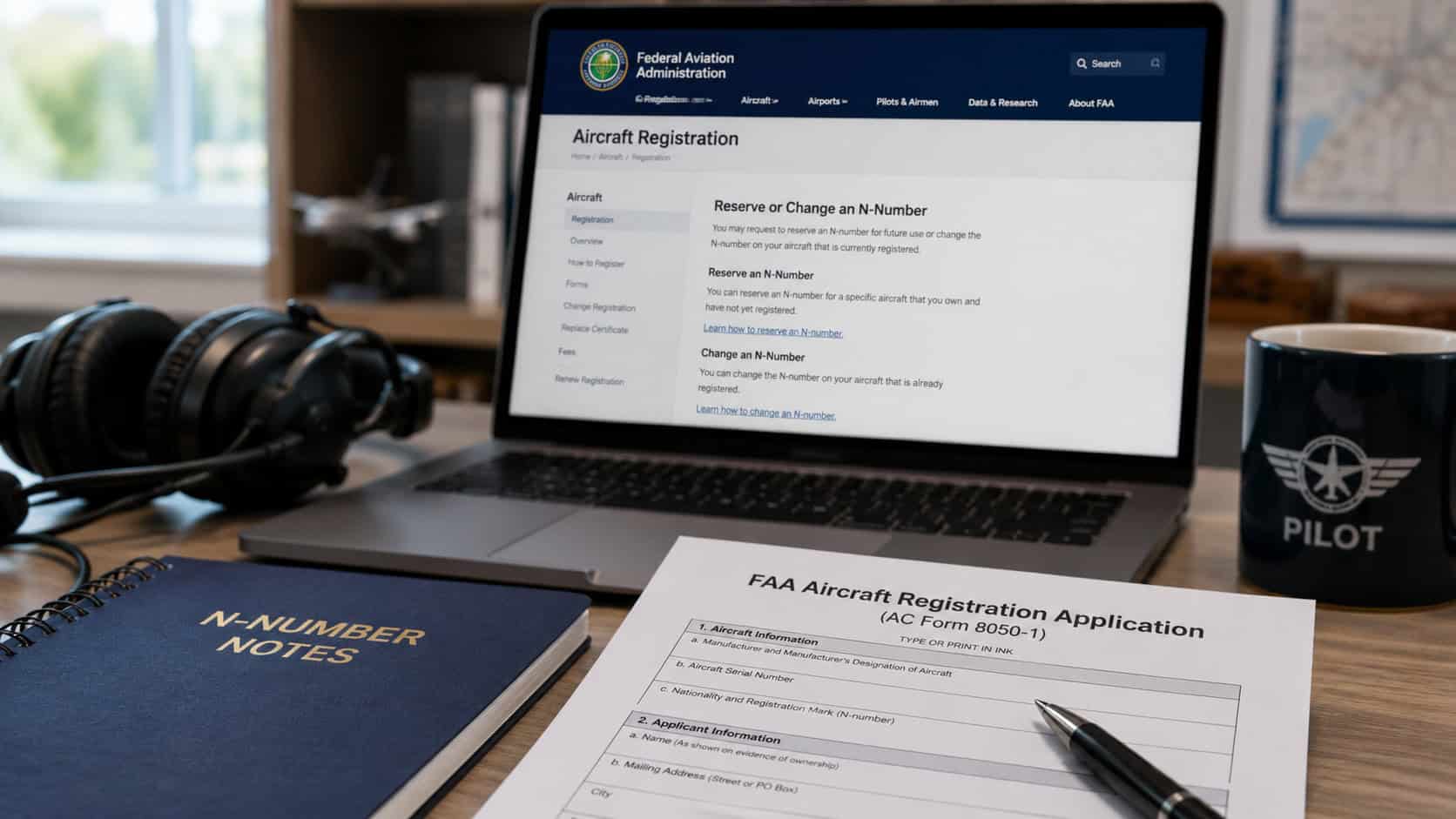
For plenty of aircraft owners, an N-number starts out as paperwork and eventually becomes part of the airplane’s identity. It is the registration you hear on the radio, write in the logbook, spot across the ramp and sometimes remember long after the airplane has changed hands.
That makes choosing a particular number surprisingly personal. An owner might want initials, a meaningful date, a short number that is easy to say on the radio, or simply a registration that feels right for the airplane.
The FAA allows owners and prospective owners to reserve certain available registration numbers, officially called special registration numbers. But reserving a number, assigning it to an aircraft and physically changing the markings on an existing airplane are separate steps with different requirements.
If you are still getting familiar with the terminology, start with our guide to what an aircraft tail number is and why U.S. aircraft use N-numbers.
Quick Answer: How Do You Reserve an N-Number?
You can search the FAA Aircraft Registry for an available N-number and submit an online reservation request. A special registration number may be reserved for up to one year and can be renewed for additional one-year periods. The current FAA fee for reserving a registration number is $10.
A reservation does not by itself change the number painted on an aircraft. Assigning a reserved number to an airplane, changing the aircraft markings and updating its registration and airworthiness documents are separate parts of the process.
Important: An N-number that appears available in the FAA search is not guaranteed until the FAA processes the request because other requests may already be pending.
What Is a Special N-Number?
The FAA uses the term special registration number for an available N-number selected by an applicant rather than simply accepting a number otherwise assigned through the registration process.
Under 14 CFR § 47.15, an available, unassigned U.S. registration number may be assigned as a special registration number. The FAA also allows a special number to be reserved for future use.
That distinction matters. A reserved number is being held in your name. It has not automatically become the registration number of your airplane.
Special N-numbers can be used in several situations, including changing the registration number on an aircraft you already own or preparing a registration number for certain new, amateur-built, imported or newly manufactured aircraft.
What Makes an N-Number Valid?
You cannot simply combine any letters and numbers after the N. Federal regulations establish the basic format, and the FAA reservation system applies those rules when you search.
A U.S. registration number can contain no more than five characters after the prefix letter N. Valid formats include:
- One to five numbers, such as N12345
- One to four numbers followed by one letter, such as N1234A
- One to three numbers followed by two letters, such as N123AB
The letters I and O cannot be used because they could be confused with the numerals 1 and 0. The number also cannot begin with zero. The first zero must come after at least one digit from 1 through 9.
The FAA’s online reservation system also identifies N1 through N99 as reserved for FAA internal use and unavailable for ordinary reservation.
These are regulatory and FAA system requirements, not merely radio etiquette or pilot convention.
How to Check Whether an N-Number Is Available
The FAA Aircraft Registry provides an official N-Number Availability Inquiry. This should be the starting point when you have a particular combination in mind.
Search availability before building plans around a number. A registration that looks perfect on paper may already be assigned, reserved or otherwise unavailable.
There is one important limitation: an online availability result is not a guarantee. The FAA notes that requests are received and processed continually, so the status of a number can change as other applications are handled.
Have More Than One Choice Ready
This is not a regulatory requirement when using the online reservation system, but it is sensible planning. If your first-choice number matters to you, come up with several variations before beginning the process.
A pilot choosing an N-number might experiment with:
- initials
- a meaningful aircraft-related number
- a date or year with personal significance
- a short combination that is easy to remember
- a registration that connects to the aircraft’s history
Those are matters of preference and pilot culture, not FAA requirements.
How to Reserve an Available N-Number Online
The FAA currently operates an online Aircraft N-Number Reservation service for available numbers.
The process allows the requester to enter desired registration numbers, verify the reservation information and pay the fee online. The current online reservation fee is $10.
The system allows applicants to enter multiple preferred numbers. But submitting the request does not itself guarantee that a number will be awarded. The FAA processes requests in order of receipt, and another request for the same number may already be in process.
How Long Does an N-Number Reservation Last?
Under 14 CFR § 47.15(h), a special registration number may be reserved for no more than one year at a time.
The FAA permits the reservation to be renewed for additional one-year periods. The current renewal fee is $10 for each additional year.
That makes a reservation useful even if an aircraft purchase, restoration, homebuilt project or ownership change is still some distance away. But the owner of the reservation needs to keep track of the expiration date and renew it when appropriate.
The FAA says a reserved number that is not renewed becomes available after its purge date according to the timing published by the Registry. Anyone waiting for a particular number should rely on the FAA’s current availability system rather than assuming a previously reserved number has become free.
Reserving an N-Number Is Not the Same as Assigning It
This is probably the most important distinction in the process.
When you reserve an N-number, you are holding that registration number for future use. You have not automatically reassigned an aircraft to that number.
To place a special registration number on an aircraft, the FAA must authorize its assignment to the aircraft.
That means an owner should not treat an online reservation confirmation as permission to remove the airplane’s existing registration markings and start operating under the new number.
A tail number may feel personal, but changing one is still an aircraft registration action. Choose the number for the story. Follow the FAA process for the airplane.
How to Change the N-Number on an Aircraft You Already Own
Changing an existing aircraft’s registration number requires more than reserving a desirable combination.
Current FAA Aircraft Registry guidance instructs an owner requesting an N-number change to submit a signed request identifying the aircraft by manufacturer, model designation, serial number and current U.S. registration number.
If you already hold the desired special registration number in reserve, the FAA currently requires a $10 assignment fee. If you request a new special registration number at the same time you request the aircraft number change, the FAA’s published guidance calls for $20 total: $10 for the special registration number and $10 for the number change.
Once the FAA approves the change, it issues an Assignment of Special Registration Numbers, AC Form 8050-64. That authorization is an important dividing line in the process. It is the FAA authorization associated with placing the approved new registration number on the aircraft.
After the New N-Number Goes on the Airplane
Federal regulations impose follow-up requirements after the new registration number is physically placed on the aircraft.
Under 14 CFR § 47.15(f), within five days after the special registration number is placed on the aircraft, the owner must complete and sign the Assignment of Special Registration Numbers, state the date the number was placed on the aircraft and return the original to the FAA Registry.
The regulation also requires the duplicate assignment form and the aircraft’s current Certificate of Aircraft Registration to be carried in the aircraft as temporary authority to operate under the new number until the revised registration certificate is received, subject to the regulatory time limit on that temporary authority.
The FAA’s published N-number change guidance separately instructs owners to present the duplicate AC Form 8050-64 and the existing airworthiness certificate to an FAA Flight Standards District Office within ten days after placing the new number on the aircraft so a revised airworthiness certificate showing the new N-number can be issued.
These are FAA regulatory and administrative requirements. They are different from the cosmetic work of having new registration markings produced and installed.
Do the New Aircraft Markings Have Rules Too?
Yes. The physical N-number displayed on the aircraft is governed by 14 CFR Part 45.
Among other requirements, aircraft nationality and registration marks generally must be permanent or comparably permanent, unornamented, contrasting with the background and legible. Part 45 also contains requirements governing where registration marks are displayed, their dimensions and several exceptions for particular aircraft and operations.
For many fixed-wing aircraft, the general rule in § 45.29 calls for registration marks at least 12 inches high, although the regulation contains important exceptions. Owners should check the current rule that applies to their particular aircraft rather than assuming that a marking seen on another airplane is automatically compliant.
This is one area where aesthetics need to follow the regulation. Color, placement and style can still complement a paint scheme, but the legal registration markings have to satisfy the applicable FAA requirements.
Can You Choose an N-Number Because It Means Something?
Absolutely, as long as the combination itself is valid and available.
This is where FAA paperwork crosses into aircraft-owner culture. A memorable N-number might reflect initials, a family connection, an important year, a long-running nickname or simply a number that has followed a pilot through years of flying.
That personal connection is part of why aircraft registrations become more than database entries. We explored that side of aviation in What Is a Tail Number? The Story Behind Every N-Number.
The same identity carries into how pilots talk about airplanes at the hangar, recognize friends on the radio and remember aircraft they once flew. Because the registration is also commonly used as an aircraft call sign, our explainer on aviation radio terms and why pilots say “niner” is a useful companion read.
Think Beyond the Reservation Before You Change a Tail Number
A short or meaningful number can be appealing, but aircraft owners should think through the entire change before committing.
Practical considerations can include the FAA assignment process, compliant exterior markings, updated aircraft documents and any other records or owner materials that reference the existing registration.
It is also worth separating what the regulations require from personal housekeeping. Updating your hangar sign, aircraft cover, flight-bag label, photo archive or favorite embroidered hat may make sense after a change, but those are owner choices rather than FAA registration requirements.
For pilots who enjoy carrying their aircraft identity beyond the ramp, Tail Number Gear has also covered why personalized tail-number apparel means more to aircraft owners than generic aviation merchandise and the connection between pilots, airplanes and custom tail-number hats.
A Good N-Number Becomes Part of the Airplane
The FAA sees an N-number as a nationality and registration mark, which is exactly what it needs to be from a regulatory standpoint.
Pilots often experience it differently. After enough flights, radio calls, logbook entries, fuel stops and hangar conversations, the registration starts to feel inseparable from the airplane itself.
That is what makes choosing a special N-number interesting. The process begins with an FAA database search and a reservation request, but the number you choose may become part of the aircraft’s identity for years.
Just remember the sequence: verify availability, reserve the number if appropriate, obtain FAA authorization before changing an existing aircraft’s registration, follow the required documentation steps, and make sure the physical markings comply with the applicable rules.
Carry Your Tail Number Beyond the Ramp
Once an aircraft’s registration becomes part of its identity, it is natural for some owners to make that number part of their own flying gear too. Tail Number Gear is an independent aviation apparel brand, and aircraft manufacturer and model names are used descriptively to help pilots find gear suited to the aircraft they fly.


Frequently Asked Questions About Reserving and Changing N-Numbers
How much does it cost to reserve an N-number?
The FAA currently charges $10 to reserve a special registration number. A reservation lasts for up to one year and can be renewed for additional one-year periods for the applicable renewal fee.
How long can I keep an N-number reserved?
A special registration number may be reserved for no more than one year at a time. The FAA permits annual renewals, so a number can continue to be held if the reservation is renewed properly.
Does reserving an N-number automatically assign it to my airplane?
No. Reserving a number holds it for future use. Assigning that number to an aircraft, and especially changing an existing aircraft’s registration number, requires the separate FAA assignment and documentation process.
Can an N-number contain letters?
Yes. A U.S. registration can use one to four numbers followed by one letter, or one to three numbers followed by two letters. The letters I and O are not permitted. An N-number may also consist entirely of one to five numbers, subject to FAA availability and other restrictions.
Can an N-number start with zero?
No. The first zero must be preceded by at least one digit from 1 through 9. For example, a sequence beginning N0 would not satisfy the FAA’s N-number formation rule.
Can I change the tail number on an airplane I already own?
Yes. The FAA allows an aircraft owner to request a special registration number and change the number assigned to an existing aircraft. The owner must follow the FAA assignment process, obtain authorization, update the aircraft’s registration markings and complete the required registration and airworthiness-document steps.
Can I put the new N-number on the airplane as soon as I reserve it?
No. A reservation alone is not the authorization to change an existing aircraft’s displayed registration. For an N-number change, follow the FAA assignment process and wait for the applicable authorization before placing the new number on the aircraft.

[…] the aircraft will receive a different registration number, Tail Number Gear’s guide to reserving or changing an N-number explains the separate FAA process […]