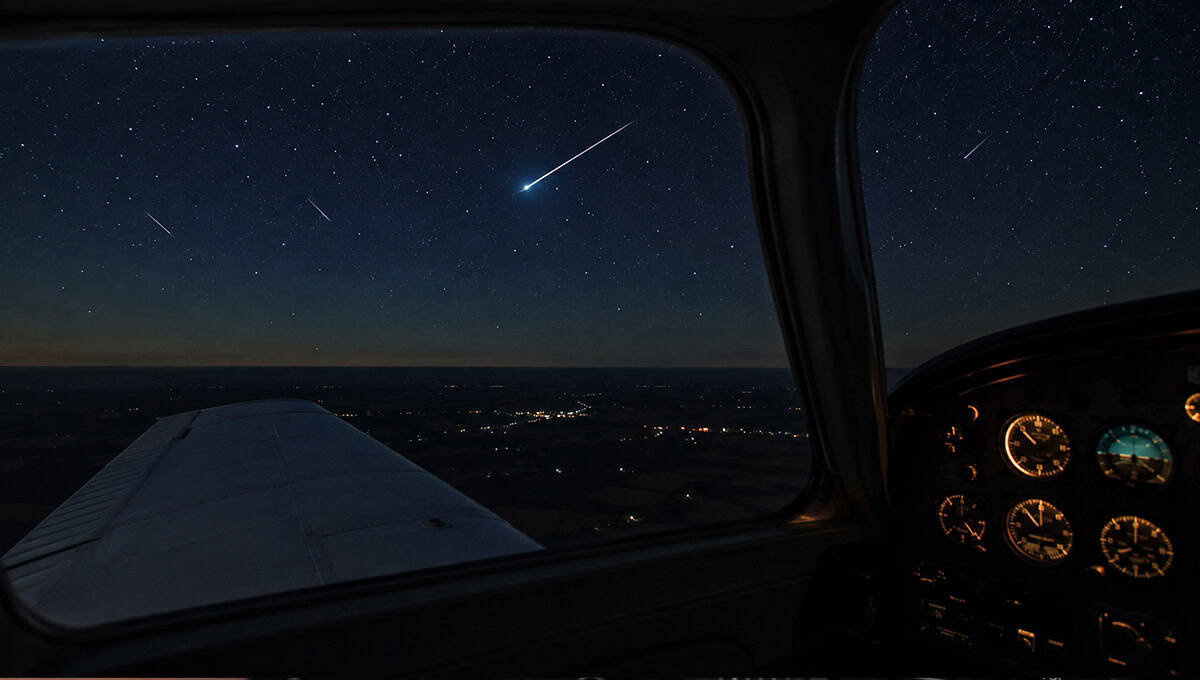
A bright streak suddenly flashes beyond the wing.
It appears without warning, races across a section of the night sky and disappears before anyone in the cockpit can say much more than, “Did you see that?”
Was it another aircraft? A satellite? Distant lightning? Space debris?
During the middle of August, there is another exciting possibility: it may have been a Perseid meteor.
The Perseid meteor shower from an airplane can be an unforgettable sight. Pilots and passengers may enjoy a darker sky than observers surrounded by city lights, and an aircraft cruising above a lower cloud layer may have a view unavailable to anyone on the ground.
But an airplane is not automatically the perfect meteor-watching platform. Cockpit lighting, window reflections, restricted visibility, aircraft heading and pilot workload can all affect what is visible.
Quick answer: Yes, you can see the Perseid meteor shower from an airplane. The best opportunity in 2026 will be late on August 12 through the predawn hours of August 13. Look across a wide area of dark sky, generally toward the northeast, but remember that meteors may appear almost anywhere.
For pilots, there is one rule more important than any viewing tip:
The flight comes first. The meteor shower is a bonus.
This article provides general educational information. It is not a substitute for current regulations, weather information, aircraft procedures, flight instruction or pilot judgment.
When Is the 2026 Perseid Meteor Shower?
The Perseids return every summer as Earth passes through a trail of debris left behind by Comet 109P/Swift-Tuttle.
According to NASA’s August 2026 skywatching forecast, the shower will peak during the evening of Wednesday, August 12, into the early morning hours of Thursday, August 13.
The timing is especially favorable in 2026 because the peak coincides with a new moon. With little or no moonlight washing out the sky, fainter meteors should be easier to see wherever weather and local lighting cooperate.
| 2026 Perseid viewing detail | What to expect |
|---|---|
| Peak night | August 12 into the predawn hours of August 13 |
| Moon conditions | New moon and exceptionally dark skies |
| General direction | Northeastern sky after full darkness |
| Best part of the night | Late evening through the hours before dawn |
| Best region | Northern Hemisphere |
The peak is not an on-and-off switch. Perseid activity builds before the strongest night and continues afterward, so a pilot flying several nights before or after August 12 may still see one.
Peak predictions can also vary slightly by location and observing method. Pilots should treat August 12–13 as the strongest general viewing window rather than expecting every meteor to arrive during one exact hour.
Can You Really See the Perseid Meteor Shower From an Airplane?
Yes. Meteors are visible from airplanes for the same reason they are visible from the ground: bright particles produce streaks of light as they enter Earth’s upper atmosphere at tremendous speed.
An observer does not need to be directly beneath a meteor. A bright Perseid may be visible across a large geographic area, and its apparent path can cover a noticeable portion of the sky.
An aircraft may offer several potential advantages:
- less surrounding light than a city or suburban neighborhood,
- a wide horizon over rural terrain or open water,
- a possible position above low clouds, haze or ground fog,
- and fewer nearby buildings, trees or terrain features blocking the view.
Those advantages do not guarantee a spectacular display. An aircraft cabin also introduces its own problems:
- reflections from instruments, phones and cabin lights,
- scratched, curved or multilayered windows,
- limited visibility in certain directions,
- flashing aircraft lights,
- and constant changes in heading, altitude or viewing angle.
A passenger on a dark airline flight may occasionally have a cleaner view than a general aviation pilot surrounded by illuminated instruments. On another flight, the opposite may be true.
The best airborne view depends on the airplane, seating position, route, weather and lighting conditions.
Are Airplanes Closer to Meteors?
Technically, an aircraft is closer to a meteor than an observer standing on the ground, but not by as much as the view may suggest.
Commercial airplanes commonly cruise roughly six to eight miles above Earth. Many general aviation airplanes fly considerably lower.
Visible meteors normally occur much higher in the atmosphere. NASA explains that most meteors burn in the mesosphere, with visible meteor activity commonly occurring around 50 miles above Earth or higher.
That means an airliner at 35,000 feet remains dozens of miles below the luminous portion of a typical Perseid meteor.
The view can feel close because the observer has few familiar objects against which to judge distance. A brilliant meteor may appear to pass just beyond the wing even though it is actually far above the aircraft and many miles away horizontally.
Aviation perspective: Flying altitude may remove some clouds and ground light from the view, but an airplane does not fly through the visible Perseid meteor shower.
Do Meteor Showers Pose a Danger to Aircraft?
An ordinary annual meteor shower does not present a meaningful operational danger to aircraft.
Most of the particles responsible for the Perseids are tiny pieces of comet material. NASA notes that much of the debris producing meteor showers ranges from about the size of a grain of sand to a pea. Most disintegrates high in the atmosphere.
A meteor shower may look intense because observers see numerous bright streaks over time, but those streaks occur across a huge volume of the upper atmosphere. They are not a concentrated layer of rocks through which an airplane must fly.
Large meteoroids and meteorite-producing fireballs are different phenomena, but they are rare and are not a practical reason to avoid flying during the Perseids.
The more realistic aviation concerns on an August night remain familiar ones:
- weather,
- visibility,
- cloud clearance,
- terrain and obstacles,
- aircraft condition,
- pilot proficiency,
- fatigue,
- and suitable emergency landing options.
A pilot should never allow an interesting event in the sky to distract from those risks.
Where Should You Look for the Perseids From an Airplane?
NASA recommends beginning with the northeastern sky after it becomes fully dark and watching for the constellation Perseus to rise above the horizon.
Perseus contains the shower’s radiant, the point from which the meteors appear to spread outward. The constellation is useful for identifying the shower, but the meteors are not confined to that small section of sky.
A Perseid can flash across almost any part of the visible sky.
In fact, staring directly at the radiant is not always the best approach. Meteors near the radiant may appear short because they are moving more directly toward the observer. Meteors farther from it can produce longer, more dramatic streaks.
The best technique is to begin in the general direction of Perseus, then scan a broad area rather than fixing your eyes on one point.
Which Side of the Airplane Is Best?
There is no universally correct side.
The better side depends primarily on the aircraft’s heading and which windows offer a darker, less obstructed view toward the northern and eastern sky.
For example:
- An aircraft flying north may place the northeastern sky more toward its right side.
- An aircraft flying south may place the northeastern sky more toward its left or rear quarter.
- An eastbound aircraft may offer useful views from both forward side windows, depending on the time.
- A westbound passenger may need to look behind the wing or across the opposite side of the cabin.
Turns, deviations and route changes can alter the best side within minutes.
Passengers choosing an airline seat can examine the planned route and compare it with the northeastern sky, but flight plans and runway assignments can change. No seat selection guarantees a meteor view.
When Is the Best Time to See the Perseids While Flying?
The Perseids can become visible during the late evening, but viewing generally improves as the night progresses.
Perseus climbs higher after midnight, placing more of the meteor activity above the horizon. The predawn hours often provide the strongest opportunity.
For the 2026 peak, a flight operating between late evening on August 12 and the early morning of August 13 has the best overall timing.
That does not mean a pilot should schedule an unnecessary predawn flight solely for the shower. The benefits of a dark sky must be weighed against fatigue, weather, proficiency and the reduced emergency options associated with night flight.
A safe flight that already fits the pilot’s mission may create a memorable viewing opportunity. The meteor shower should not become the mission itself.
How Cockpit Lighting Affects the View
The human eye needs time to adapt to darkness. Bright instrument panels, tablets, phones and cabin lights can make faint stars and meteors disappear from view.
The FAA’s night operations guidance advises keeping cockpit and instrument lighting as dim as practical so the eyes can adjust to outside conditions.
That does not mean turning off equipment needed to fly safely.
The goal is to use the lowest lighting level that still allows every required instrument, control, chart and checklist item to be read clearly.
Good night-light discipline includes:
- dimming displays to a comfortable but readable level,
- using night mode on approved electronic flight displays,
- avoiding an unnecessarily bright phone screen,
- shielding passenger devices from the windshield,
- and keeping loose flashlights from shining directly into anyone’s eyes.
A passenger opening a bright white screen can temporarily destroy the cockpit’s dark adaptation. A short passenger briefing before departure can prevent that problem.
Use Off-Center Vision Instead of Staring
Human night vision works differently from daylight vision.
The center of the visual field is excellent for seeing fine detail in daylight but is less effective at detecting faint objects in darkness. The FAA teaches an off-center viewing technique in which the observer looks slightly to one side of a dim object instead of staring directly at it.
This allows the more light-sensitive areas of the retina to help detect faint movement.
For meteor watching, use a slow scan across the sky:
- move the eyes through small sections,
- pause briefly in each section,
- avoid staring at one point for too long,
- and continue the normal traffic and instrument scan.
A pilot’s scan must remain focused on flying and collision avoidance. Meteor watching never replaces looking for other aircraft, monitoring instruments or maintaining situational awareness.
How to Tell a Meteor From an Aircraft or Satellite
At night, an unexpected light can be difficult to identify immediately.
A typical meteor:
- appears suddenly,
- moves very quickly,
- usually lasts only a fraction of a second or a few seconds,
- may brighten or change color,
- and often leaves a short-lived glowing trail.
A satellite normally moves more slowly and steadily across the stars. It may remain visible for several minutes and usually does not flash like an aircraft strobe, although tumbling satellites can vary in brightness.
Another aircraft may show a combination of red, green, white or flashing lights. Its apparent movement can be surprisingly slow, especially when it is approaching nearly head-on.
Distant lightning may illuminate a cloud or horizon without producing a clean streak across the stars.
These are general visual clues, not a collision-avoidance system. A pilot who cannot positively identify a light should continue treating it as possible traffic or weather until the situation is clear.
Clear radio communication remains part of that awareness. Our guide explaining why pilots say “niner” and use standardized aviation terms shows how precise phraseology helps pilots and controllers understand one another when conditions become busy or uncertain.
Can Clouds Improve the View From an Airplane?
Being above a low cloud deck may dramatically improve the view compared with the ground.
Low clouds can block city lighting and create a darker background above the aircraft. A pilot cruising over an undercast may see stars and meteors while people below see nothing but clouds.
However, clouds do not always help.
- High cirrus can soften or hide faint meteors.
- Moisture and haze can scatter light.
- Cloud tops illuminated by cities or the aircraft’s lights can create glare.
- An overcast night can eliminate a reliable natural horizon.
The FAA warns that dark terrain, sparse lighting and poorly defined horizons can create misleading visual cues. A beautiful sky does not make marginal night weather safe.
Pilots should obtain a complete weather briefing and make the same conservative decisions they would make on any other night flight.
Should a Pilot Change Course to See More Meteors?
No flight should be made less safe simply to improve the view.
A pilot should not enter weather, approach restricted airspace, descend below an appropriate altitude, delay a needed landing or accept an unfavorable fuel situation to chase a meteor shower.
A minor heading adjustment might be harmless in open airspace when coordinated properly, but even that should have an operational purpose and should never interfere with navigation, traffic avoidance or air traffic control instructions.
The safest approach is simple:
Plan a normal, well-considered night flight. If the Perseids appear along the way, enjoy them without allowing them to change the priorities of the flight.
The same principle applies to other aerial spectacles. Our article about flying near fireworks on the Fourth of July explains why an impressive view never removes the need for disciplined night-flying decisions.
Can You Photograph the Perseids From an Airplane?
It is possible, but photographing meteors through an aircraft window is difficult.
Meteors appear without warning and disappear quickly. The airplane is moving, the window may distort the image and interior reflections can overwhelm faint details.
Most importantly, the flying pilot should not attempt meteor photography while operating the aircraft. Photography should be handled by a passenger or another crewmember when doing so is safe and permitted.
A passenger can improve the odds by:
- choosing the darkest available window,
- turning off the camera flash,
- wearing dark clothing to reduce reflections,
- placing a dark cloth around the camera and window area,
- using a wide-angle lens to capture more sky,
- focusing manually near infinity,
- increasing ISO rather than relying on an extremely long exposure,
- and taking repeated photographs rather than trying to predict a meteor.
Do not press a camera firmly against a vibrating window. That can transfer aircraft vibration directly into the image.
NASA’s general meteor photography guide recommends wide-angle lenses, manual focus and dark locations. Some ground-based techniques, particularly using a tripod and very long exposures, may not translate well to a moving airplane.
A sharp image of the wing beneath a star-filled sky may be more realistic than capturing a meteor itself.
Passenger Tips for Watching a Meteor Shower From a Plane
Passengers have more freedom to watch continuously, but a few simple choices can improve the experience.
- Choose a window seat. A window with minimal scratches and a clear view away from the wingtip strobe is ideal.
- Reduce screen brightness. Give your eyes time to adapt before expecting to see faint meteors.
- Block reflections. A jacket or dark blanket held around the viewing area can reduce cabin glare without obstructing safety equipment.
- Look broadly. Do not stare only at Perseus. Scan a large section of sky.
- Be patient. Meteor activity is uneven. Several may appear within minutes, followed by a quiet period.
- Follow crew instructions. Keep aisles, exits and safety equipment unobstructed.
Passengers should also keep expectations realistic. Published hourly meteor rates assume ideal dark-sky conditions with an unobstructed view of much of the sky. A small aircraft window exposes only a fraction of that area.
A Safe Pilot’s Checklist for the 2026 Perseids
- Check the complete weather picture, not just cloud cover.
- Review sunset, moon phase and expected viewing time.
- Confirm night currency and personal proficiency.
- Inspect all required aircraft lighting.
- Carry reliable flashlights and backup lighting.
- Use conservative fuel planning.
- Consider terrain and emergency landing options.
- Brief passengers about sterile-cockpit periods.
- Ask passengers to keep screens dim during cruise.
- Maintain the normal instrument and traffic scan.
- Never sacrifice safety to improve the view.
Late-summer flying can create remarkable aviation memories, from breakfast runs and fly-ins to quiet flights beneath a sky full of stars. Our collection of summer flying traditions pilots look forward to explores more of the experiences that make this season special.
Why the 2026 Perseids Could Be Worth Watching
Not every meteor shower arrives under favorable moon conditions.
In 2026, the Perseid peak occurs alongside a new moon, removing one of the biggest natural sources of nighttime glare. Weather permitting, observers across much of the Northern Hemisphere should have unusually dark skies.
For someone already making a safe night flight on August 12 or early August 13, the timing creates a rare opportunity.
A bright Perseid beyond the wing may last only a second. Yet that second can become one of those small aviation memories that remains vivid for years: the glow of the instruments, the dark horizon, the steady sound of the engine and a streak of light appearing high above an aircraft identified by its own familiar tail number.
That connection between pilot and airplane is what inspires custom tail number apparel personalized with the registration and aircraft silhouette behind those memories.
Frequently Asked Questions
Can you see the Perseid meteor shower from an airplane?
Yes. Pilots and passengers can see Perseid meteors from an airplane when the sky is clear and sufficiently dark. Visibility depends on the aircraft’s heading, window position, interior lighting, cloud layers and the observer’s night adaptation.
When does the Perseid meteor shower peak in 2026?
NASA forecasts the 2026 Perseids to peak during the evening of August 12 into the early morning hours of August 13. A new moon on August 12 should provide exceptionally dark viewing conditions.
Which direction should I look for the Perseids?
Begin by looking generally toward the northeast after full darkness, where the constellation Perseus rises. Do not stare at one small area because Perseid meteors can appear across nearly any part of the sky.
Which side of an airplane is best for watching the Perseids?
There is no single best side. It depends on the aircraft’s heading and which side offers a darker, clearer view toward the northern and eastern sky. Turns and route changes can alter the preferred side during the flight.
Are meteor showers dangerous to airplanes?
Ordinary meteor showers do not pose a meaningful operational danger to aircraft. The small particles responsible for most Perseids burn up dozens of miles above normal aircraft cruising altitudes.
Can an airplane fly through a meteor shower?
Not in the way the phrase suggests. Airplanes fly far below the upper-atmosphere region where typical meteors become visible and disintegrate.
Does flying above the clouds improve meteor visibility?
It can. An aircraft above low clouds may escape ground-level cloud cover and some city light. High clouds, haze, illuminated cloud tops and window reflections can still reduce visibility.
Can a pilot photograph the meteor shower while flying?
The pilot operating the aircraft should not become distracted by photography. A passenger or nonflying crewmember may attempt photographs when it is safe and permitted.
How can I tell a meteor from another aircraft?
A meteor usually appears suddenly, moves extremely quickly and disappears within seconds. Aircraft lights generally move more slowly and may show regular flashes or red, green and white navigation lights. Any unidentified light should still be treated cautiously until the pilot is certain it is not traffic.
How many Perseid meteors will I see from a plane?
There is no guaranteed number. Published meteor rates assume excellent ground-based viewing with a broad, unobstructed sky. An aircraft window limits the visible area, so an observer may see only a few meteors even during an active period.