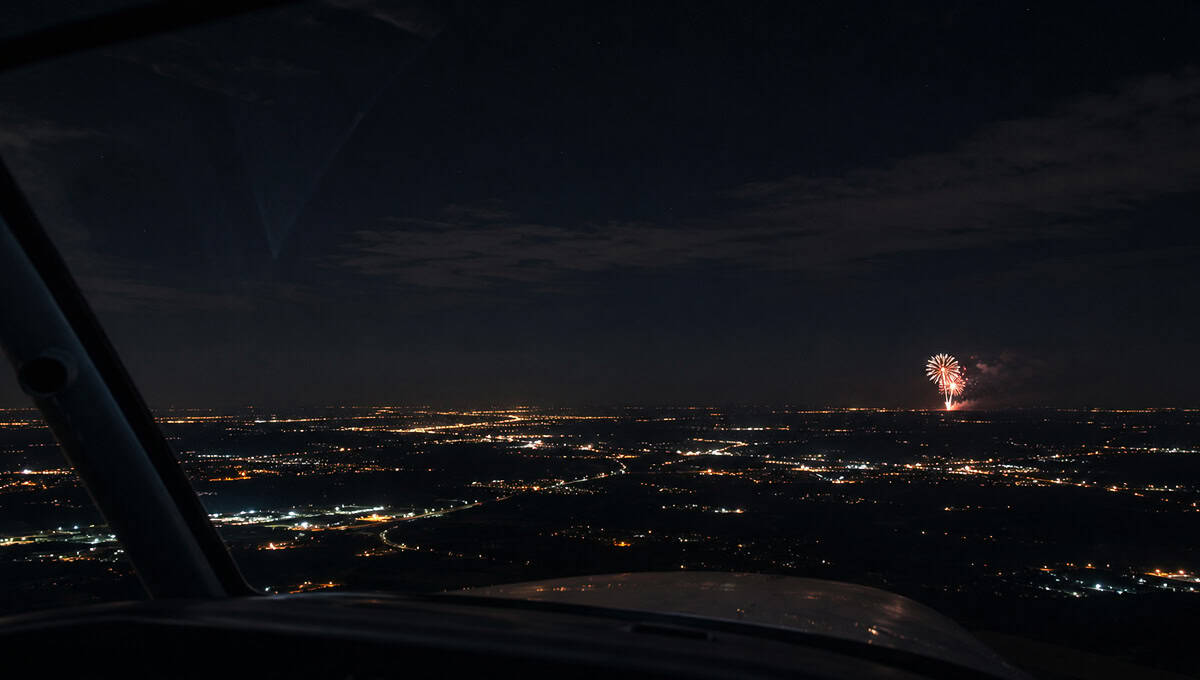
The Fourth of July is one of those summer holidays that seems made for aviation. The weather is often flyable, daylight stretches late into the evening, and airports are full of energy. Some pilots plan a quick sunset flight. Others think about taking off after dinner, enjoying city lights from above, or even trying to catch a fireworks display from the air.
That naturally leads to a question many pilots ask this time of year:
Can you fly over fireworks?
The short answer is: sometimes legally, but not always wisely.
Flying during the Fourth of July can be memorable, but it also comes with extra considerations. Night currency, traffic, distractions, NOTAMs, airport lighting, fatigue, and plain old decision-making all matter more than they might on a routine daytime local flight.
Here is what pilots should keep in mind before flying on the Fourth of July weekend.
Can Pilots Legally Fly Over Fireworks?
In general, there is no blanket rule that says a pilot may never fly near or over fireworks. But that does not mean every holiday flight is a good idea.
Legality depends on several things, including:
- whether any airspace restrictions are in place
- whether you are operating in compliance with applicable regulations
- whether you are night current if carrying passengers
- whether you can maintain safe separation, situational awareness, and sound judgment throughout the flight
The bigger point is this: a legal flight can still be a poor decision.
Many pilots are drawn to the same event at the same time. Add reduced visibility, visual distractions, unfamiliar lighting, and the temptation to “take one quick look,” and what seems like a fun holiday flight can quickly become more complicated than expected.
Check NOTAMs and TFRs First
Before you even think about loading passengers and heading to the airport, check for NOTAMs and TFRs.
Holiday events, public gatherings, VIP movements, and other special operations can affect airspace access. Even if the fireworks themselves do not automatically create a restriction, a related event or nearby operation might.
This is not the night to assume, “It should be fine.”
A good Fourth of July preflight starts with:
- checking NOTAMs
- reviewing any TFRs
- confirming airport operating hours
- verifying lighting availability if arriving or departing after dark
- making sure your route still makes sense at the planned time of departure
If you have not reviewed the latest information, you are not ready for a holiday night flight.
Night Currency Is Not the Same as Night Proficiency
This is one of the most important parts of the conversation.
A pilot may feel reasonably comfortable flying after sunset, but comfort is not the same as legal readiness or actual proficiency.
If you plan to carry passengers at night, you need to make sure you are night current. More importantly, ask whether you are truly night proficient.
Those are two different things.
A pilot may technically meet the currency requirement and still not be sharp enough for a busy holiday evening with extra traffic, distractions, and unusual visual conditions.
Ask yourself:
- Have I flown at night recently?
- Have I done more than the minimum?
- Am I comfortable with night takeoffs and landings right now?
- Would I feel confident if I had to divert, go around, or land at an airport with limited visual cues?
- Am I doing this because it is a smart flight, or because it sounds fun in the moment?
If your honest answer is, “I’m legal, but rusty,” that is your answer.
Holiday Traffic Can Be Harder Than Expected
Even if the weather is perfect, the Fourth of July can bring a different kind of operational risk: more airplanes with similar ideas.
On holiday evenings, pilots may be:
- taking short sightseeing flights
- flying to dinner or a fly-in event
- returning home after a day trip
- trying to watch fireworks from nearby airspace
- operating in and out of smaller airports around sunset
That can mean more radio chatter, more aircraft near familiar landmarks, and more pilots dividing their attention between flying and sightseeing.
The danger is not just your own distraction. It is the possibility that someone else is also trying to “just take a quick look.”
Holiday flights reward discipline. Fly your plan. Keep your scan moving. Avoid impulsive reroutes just because something looks interesting off your wingtip.
Fireworks Are a Distraction, Not a Flight Objective
From the ground, fireworks are fun. From the cockpit, they can become a serious distraction.
Bright flashes, smoke, dark surroundings, shifting focal points, and the temptation to keep looking outside the airplane instead of at instruments or traffic can all work against you.
It is easy to imagine a pilot saying:
“I’ll just circle once.”
“I’ll take a quick pass.”
“I’ll show the passengers.”
“We’re already here anyway.”
That is exactly the kind of casual thinking that can erode margins.
The real issue is not whether fireworks are beautiful from the air. The issue is whether viewing them changes your priorities in the cockpit.
If fireworks become the main event instead of safe aircraft operation, the flight has already gone in the wrong direction.
Night Flying Adds Its Own Challenges
The Fourth of July is also a night-flying topic, and night flying always deserves respect.
Even a short local flight after dark can feel very different from the same route in daytime. Familiar landmarks may disappear. Horizons can become less distinct. Terrain can blend into darkness. Airport environments may look different than expected.
On a holiday evening, that can be compounded by:
- glare from city lighting
- smoke from fireworks
- reduced contrast in the surrounding area
- fatigue after a full day in the heat
- pressure from passengers who want to “see the show”
- changing weather late in the day
That is why a Fourth of July flight should be treated like a real night operation, not an informal scenic hop.
Airport and Ground Operations Matter Too
Some of the biggest problems happen before takeoff or after landing.
Do not overlook the practical details:
1. Airport Lighting
If you are departing or returning after dark, confirm runway lighting, taxiway lighting, and any pilot-controlled lighting procedures.
2. Fuel Availability
Holiday hours may be different. A self-serve pump may be your only option, and not every airport has exactly what you expect available.
3. Local Activity
A small airport that feels quiet during the day may have more evening traffic than usual on a holiday. Be ready for congestion in the pattern or on the ramp.
4. Heat and Fatigue
July flying often means high temperatures all day long. Even if the departure is after sunset, the pilot may already be dealing with dehydration, fatigue, or reduced focus from a long day outside.
This is a good place to remember that summer flying conditions begin long before dark. If you have not read our article on density altitude, it is worth reviewing before any hot-weather holiday trip:
https://tailnumbergear.com/density-altitude-explained-summer-flying/
A Smart Fourth of July Go/No-Go Mindset
If you are considering a holiday evening flight, here is a simple way to think about it:
Good reasons to go:
- you are current and proficient
- the airplane is ready
- weather is favorable
- airport operations are straightforward
- you have a clear purpose and a conservative plan
- you are comfortable canceling if anything changes
Bad reasons to go:
- “It’ll probably be fine”
- “We’re only going for a few minutes”
- “The passengers really want to see it”
- “I don’t fly at night much, but this should be easy”
- “I know the area well, so I don’t need to worry about much”
The Fourth of July is not the time to stretch your comfort zone.
A Practical Fourth of July Pilot Checklist
Before flying on the holiday, ask yourself:
- Am I night current if I am carrying passengers?
- Am I night proficient, not just legal?
- Have I checked NOTAMs and TFRs?
- Have I reviewed weather for the full time period of the flight?
- Am I comfortable with the route after dark?
- Have I confirmed airport lighting and fuel availability?
- Am I prepared for more traffic than usual?
- Am I willing to avoid the fireworks area completely if it looks busy or distracting?
- If conditions are not ideal, am I willing to stay on the ground?
If any of those answers feel uncertain, it may be smarter to enjoy the holiday from the ground.
Sometimes the Best View Is Not from the Cockpit
There is nothing un-pilot-like about deciding not to go.
In fact, one of the best traits a pilot can have is the ability to separate a cool idea from a wise decision.
Some Fourth of July evenings are great for a well-planned flight. Others are better suited for a lawn chair near the airport, a sunset meal with friends, or simply watching the fireworks without cockpit distractions.
Aviation is supposed to be enjoyable, but it should never become casual.
Final Thoughts
So, can you fly over fireworks?
Sometimes, yes.
But the better question is:
Should you?
For many pilots, the safest answer is to avoid turning fireworks into the focus of the flight. If you do fly on the Fourth of July, treat it like any other real night operation: plan carefully, stay current, stay disciplined, and never let the holiday atmosphere push you into a poor decision.
Summer flying can be some of the most rewarding flying of the year. If you want more seasonal pilot reading, check out:
https://tailnumbergear.com/summer-flying-traditions/
And if you are heading to the airport for a holiday breakfast flight, evening hangar gathering, or weekend trip, you can also browse Tail Number Gear favorites like:
- Pilot Hats: https://tailnumbergear.com/pilot-lifestyle-apparel/pilot-hats/
- For Cessna Pilots: https://tailnumbergear.com/shop-by-aircraft/high-wing-aircraft-gear/for-cessna-pilots/
- For Cirrus Pilots: https://tailnumbergear.com/shop-by-aircraft/low-wing-aircraft-gear/for-cirrus-pilots/
- For Piper Pilots: https://tailnumbergear.com/shop-by-aircraft/low-wing-aircraft-gear/for-piper-pilots/
Fly smart, enjoy the holiday, and keep the decision-making as sharp as the flying.
FAQs
Can pilots legally fly over fireworks?
Sometimes, depending on the airspace, local restrictions, and the overall safety of the operation. Pilots should always check NOTAMs and TFRs before flying and should avoid letting sightseeing interfere with safe aircraft operation.
Do fireworks create a TFR?
Not automatically in every case, but related event activity or other temporary restrictions may affect the area. That is why checking current NOTAMs and TFRs is essential before a Fourth of July flight.
Do I need to be night current to carry passengers on July 4?
Yes. If you are carrying passengers during the applicable night period, you need to meet the FAA night-currency requirement.
Is flying at night on the Fourth of July more dangerous?
It can be more demanding than a routine night flight because of extra traffic, distractions, glare, smoke, fatigue, and holiday pressure. It requires conservative judgment.
Should student pilots fly on the Fourth of July at night?
That depends on training, endorsements, experience, weather, and instructor guidance. In general, a busy holiday evening is not the best time to push into more complex flying conditions.